
When comparing used SUVs for sale near Summerlin Las Vegas, look beyond the asking price. Compare each vehicle’s make, model, mileage, condition, drivetrain, seating, cargo space, and listed features. A model may have several trims, so check the equipment on the specific vehicle rather than relying on the model name alone.
Start with your budget, then narrow the options to the space and features you’ll use every day. This guide explains how to compare asking prices and vehicle details, what to consider across makes and models, and how mileage and drivetrain factor into your choice. We also cover seating, cargo room, and features that may suit commuting, errands, and weekend plans around Las Vegas.
Key Takeaways
- Compare asking prices alongside mileage, condition, trim, and features to understand how similar SUVs differ.
- Check seating and cargo space against your regular passenger and storage needs before choosing a size.
- Consider how drivetrain and included features fit your usual driving around Las Vegas.
- The Jeep Compass is available in five trims, so compare equipment as well as model name.
Used SUV inventory in Las Vegas
Inventory around Summerlin changes as vehicles sell and new trade-ins arrive. When comparing used SUVs for sale near Summerlin Las Vegas, we look at model, asking price, mileage, drivetrain, and vehicle condition. The Jeep Compass is available in five trims, so we compare each listing’s trim and equipment rather than relying on its model name alone. SUV and crossover listings had an overall rating of 4.6 stars, which we treat as a starting point alongside vehicle-specific details.
Search across Las Vegas, not just one neighborhood. A wider location radius can reveal more options, while a shorter radius may make test-drive planning easier. Use online inventory filters to narrow results by make, model, price, mileage, drivetrain, seating, and features. Start with priorities such as all-wheel drive or a third row, then compare condition and equipment. Saving suitable listings makes side-by-side comparisons easier.
Which dealerships near Summerlin, Las Vegas, sell used SUVs? Franchise dealerships and independent used-car dealerships across Las Vegas list pre-owned SUVs, with inventory varying by location and vehicle turnover. We use location filters to identify nearby listings, then compare posted details rather than assuming every dealership carries the same makes or models.
What used SUVs are currently listed for sale near Summerlin? The Jeep Compass is one named option, and its five trims give buyers different equipment levels to compare. Other live listings change as vehicles are added or sold, so we filter current inventory by preferred body size, drivetrain, mileage, and budget before building a shortlist.
Certified pre-owned inventory differs from a standard used listing because the label refers to a manufacturer’s program. Check a listing for the program name, eligibility details, inspection information, and any stated coverage. The word “certified” alone doesn’t explain the full program. Compare certified and non-certified vehicles using mileage, condition, equipment, and asking price.
What Nevada taxes, registration fees, and title costs apply to buying a used SUV? Budget for applicable sales tax, title processing, and registration costs in addition to the vehicle’s price. The total depends on the sale and vehicle details, so include these costs when comparing an SUV’s full purchase cost with your budget. Contact the dealer to confirm the full out-the-door price.
Private-seller purchases may come with fewer written details about a vehicle’s history, condition, or title. With any seller, review the paperwork, match the vehicle identification number on the SUV to its documents, and arrange an independent inspection before agreeing to buy.
How can you check a used SUV’s vehicle history and title status before buying? Match the vehicle identification number across the dashboard, door label, and title, then review a vehicle history report and title document. Look for inconsistencies in ownership, reported damage, mileage, or title branding, and check that the seller’s name aligns with the paperwork.
A Jeep Compass is one available option, with five trims offering different equipment; other choices depend on current inventory.
Comparing SUV seating, cargo space, drivetrain, mileage, and features
Compare each vehicle with how you’ll use it, not just its listing photos. A consistent checklist helps you weigh comfort, capability, mileage, and condition before arranging a test drive.
Seating and Cargo Space
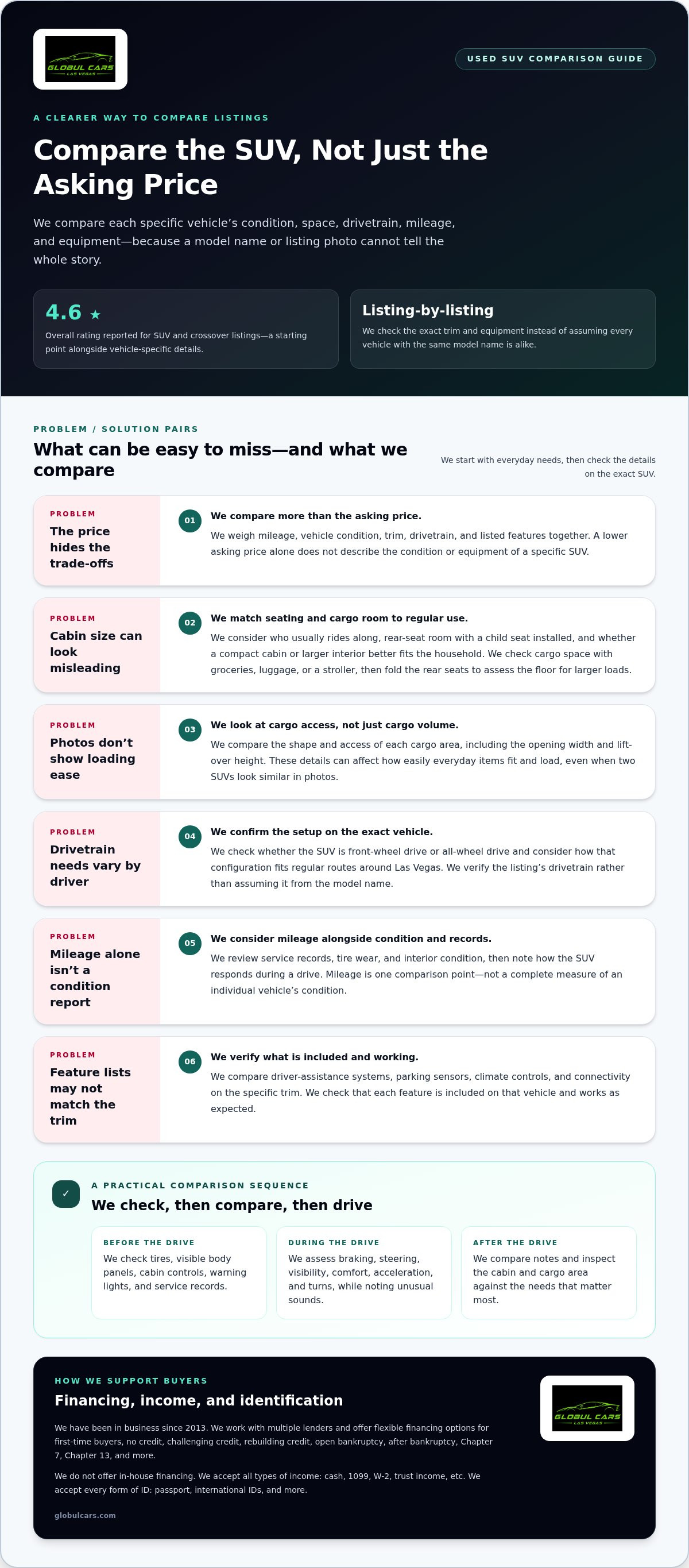
Start with the people and gear you carry most often. A compact SUV may suit a driver who usually travels alone or with one passenger, while a larger cabin can better accommodate family members. Check whether the rear seats provide enough room for regular passengers, including when a child seat is installed.
Test cargo space with everyday items such as groceries, luggage, or a stroller. Fold the rear seats to see whether the resulting floor works for larger loads, and compare the shape and access of each cargo area. A wide opening or lower lift-over height can make loading easier, even when two vehicles look similar in photos.
Drivetrain, Mileage, and Features
Check whether each SUV has front-wheel drive or all-wheel drive, then consider your regular routes around Las Vegas. Drivetrain affects how a vehicle delivers power to its wheels, so compare the configuration with your driving needs rather than assuming one option suits everyone. Confirm the drivetrain for the exact vehicle, not just its model name.
Use mileage as one comparison point, not a complete measure of condition. Review service records, tire wear, and interior condition, and note how the vehicle responds during a drive. Then compare useful features such as driver-assistance systems, parking sensors, climate controls, and connectivity. Verify that each feature works and is included on the specific trim.
Which used SUVs near Summerlin offer the best value and reliability? A vehicle may represent strong value when its asking price, mileage, condition, maintenance history, and features match your needs. Compare those details across similar SUVs, since a model name alone doesn’t establish an individual vehicle’s condition.
What should you inspect and test-drive when buying a used SUV? Check the tires, visible body panels, cabin controls, warning lights, and service records. Then drive on streets that let you assess braking, steering, visibility, and cabin comfort. Listen for unusual sounds and note how the SUV accelerates and handles turns.
To schedule a test drive, shortlist specific vehicles and contact the dealership to arrange a time. Identify the exact listing by its make, model, and trim so you can focus on the vehicle you compared. Bring a driver’s license, plan a route with ordinary stops and turns, and leave time to inspect the cabin and cargo area afterward. If you’re considering multiple SUVs, allow enough time between drives to record notes while details are fresh.
SUV makes and models
Make and model narrow the search, but the specific vehicle still matters. A Jeep Compass, Chevrolet Equinox, and Toyota RAV4 can all suit compact-SUV shoppers, yet their trim names, equipment, mileage, and condition differ. Compare the exact listing rather than assuming every vehicle from one manufacturer has the same strengths.
Jeep’s used SUV range includes models such as the Compass, Wrangler, and Grand Cherokee. The Compass is available in five trims, which means equipment can vary even within the same model year. Wrangler listings may appeal to drivers prioritizing an open-air design, while Grand Cherokee listings offer a different style of SUV. Treat these as starting points, then assess each vehicle’s condition and equipment.
Compare SUVs by size, layout, and the details of each specific listing. A compact SUV and a larger family SUV serve different needs, and model names alone don’t establish a vehicle’s condition or value. Check the seating, cargo space, mileage, and equipment on the vehicle you’re considering.
Other familiar model comparisons include the Honda CR-V and Pilot, Toyota RAV4 and Highlander, and Ford Escape and Explorer. These examples help separate compact options from larger models before reviewing individual listings. Use make and model filters to build a focused shortlist, then compare vehicles with similar age, mileage, trim, drivetrain, and included equipment.
- Start with the model: Choose examples such as Compass, Equinox, or CR-V that fit your intended use.
- Compare trim names: Check the exact trim because features can differ within a model line.
- Review the listing: Match the model year, mileage, drivetrain, condition, and equipment.
For a used Jeep SUV, decide whether the Compass, Wrangler, or Grand Cherokee best matches your priorities. Then compare listings within that model instead of judging by brand reputation alone. The Compass’s five trims make this step especially useful: confirm which trim appears in the listing and note the equipment actually shown.
Finally, keep your shortlist manageable. Select a few models, record each vehicle’s asking price and key details, and compare like with like. A Chevrolet Equinox and Toyota RAV4 may be closer comparisons than an Equinox and a larger Traverse. This simple grouping makes differences easier to spot and helps you choose which listings deserve a closer look.
Compact and three-row SUV options
Choosing between a compact SUV and a three-row SUV starts with passenger count and daily cargo needs. A compact vehicle can be easier to park for errands around Summerlin, while a third row gives families more seating flexibility. Compare the exact vehicle’s layout, because model year and trim can change cabin features.
For compact options, consider listings such as a Jeep Compass, Honda CR-V, or Chevrolet Equinox. Focus on how each fits your regular routine rather than treating the model name as a complete comparison. A commuter who usually carries one passenger may prioritize visibility, easy parking, and space for groceries. A household transporting sports gear should check the rear cargo area with the seats in their usual position.
Use the vehicle itself to assess fit. Sit in both front and rear seats, adjust the driver’s position, and check legroom behind it. Open the hatch and test how easily you can load a stroller, bags, or other regular cargo. If you use a child seat, bring it along and confirm the seating arrangement works before choosing a compact SUV.
- For daily errands: Compare parking visibility, door access, and cargo space with rear seats upright.
- For regular passengers: Check rear-seat comfort with the front seats adjusted for actual drivers.
- For larger loads: Fold the rear seats and test the cargo opening with your usual gear.
A three-row SUV may suit drivers who regularly carry more passengers or need flexible seating. Compare vehicles such as a Kia Sorento, Hyundai Santa Fe, or Toyota Highlander by inspecting the specific listing’s seat configuration. Sit in each row, check access to the rear seats, and see how much cargo room remains when all seats are in use.
Consider the tradeoff: a third row adds seating choices, but passengers and cargo share the available cabin space. Bring the people or gear you transport most often, if practical, and test the arrangement. Fold one or more rear seats to see whether the remaining space works for luggage, groceries, or a weekend trip.
Las Vegas driving can include neighborhood streets, busy shopping areas, and longer highway trips. Test shortlisted compact and three-row SUVs on a route that reflects those conditions. Check visibility when changing lanes, ease of entering and exiting, and passenger comfort. A vehicle that fits the driveway but crowds regular passengers may not suit your everyday use.
Before deciding, write down your priorities: regular passenger count, cargo needs, parking comfort, and seat flexibility. Compare each listing against the same checklist. The best fit is the vehicle whose layout supports your actual driving routine, whether that means a compact cabin for errands or three rows for frequent passengers.
SUV asking prices
Compare SUV asking prices by grouping similar vehicles, not by looking at one listing alone. A compact SUV belongs in a different size comparison from a three-row model. Model year, trim, mileage, drivetrain, condition, and included features all affect how useful a comparison is. A higher asking price alone doesn’t prove that a vehicle offers better value.
Set a budget for the vehicle, then leave room for the full transaction. Sales tax, title processing, and registration costs can add to the purchase total, with amounts depending on the transaction and vehicle details. Keep these costs separate from the listing’s asking price so you can compare SUVs against the same overall budget. Contact the dealer to confirm the full out-the-door price.
Build a simple comparison sheet for each listing. Record the make, model, year, trim, mileage, drivetrain, condition, and advertised features. Compare similar SUVs with similar equipment before weighing their asking prices. If one has substantially different mileage or features, note the difference rather than treating the listings as direct matches.
- Match vehicle size: Compare compact SUVs with compact options, and three-row SUVs with similar layouts.
- Review condition: Note visible wear, maintenance records, and any inspection findings.
- Compare equipment: Check trim, drivetrain, and features listed for each specific vehicle.
- Calculate your budget: Account for transaction costs separately from the asking price.
Mileage helps explain differences between listings, but it shouldn’t decide the comparison by itself. A vehicle with lower mileage may still need closer attention to its condition and maintenance history. Compare these details with the asking price. A clean, well-maintained trade-in tends to appraise higher, and detailing it and addressing small problems can help its evaluation.
Use online filters to narrow listings by price, make, model, mileage, and drivetrain. Then review individual vehicle details. Filters make it easier to spot a Chevrolet Equinox within your budget, for example, but they don’t replace checking its trim, condition, and included features. Save a few comparable listings and revisit them together before choosing which SUV to see.
Before a test drive, confirm the asking price and identify the exact vehicle and trim. Bring your driver’s license, review the listing, and note questions about condition or equipment. After the drive, compare your notes with other SUVs in the same category. This keeps the decision grounded in vehicle details, not just the first price you noticed.
A careful comparison gives you a clearer view of what each asking price represents. Focus on similar models, weigh mileage alongside condition, and keep transaction costs in your budget. This helps you decide which listings merit a closer look without assuming the lowest advertised price is automatically the best choice.
Globul Cars: Vehicle Financing Solutions
Globul Cars offers Vehicle Financing Solutions for shoppers considering a pre-owned SUV. We work with multiple lenders and offer flexible financing options for first-time buyers, no credit, challenging credit, rebuilding credit, open bankruptcy, after bankruptcy, Chapter 7, Chapter 13, and more. We don’t provide in-house financing.
We accept all types of income, including cash, 1099, W-2, and trust income. We also accept every form of ID, including passports and international IDs. Our pre-owned Mercedes-Benz, BMW, and Land Rover options may suit shoppers comparing luxury SUVs alongside their financing needs.
Contact Globul Cars to discuss vehicle financing solutions and available pre-owned SUV options.
Choose Your Next SUV with Confidence
Let your shortlist guide the next step. Decide which vehicle best matches your daily routine and what you still want to review in person. For shoppers comparing used SUVs for sale near Summerlin Las Vegas, a conversation with Globul Cars can help connect the vehicle choice with financing options suited to their needs.
At Globul Cars, we offer Vehicle Financing Solutions and pre-owned Mercedes-Benz and BMW options. We can help you consider those choices as you move from comparing listings toward a decision. The right next step is simply to discuss what you’re looking for and what matters most in your search.
Contact Globul Cars to continue your SUV search. We’re ready to help you take the next step at your pace.
Frequently Asked Questions
What are typical prices for used SUVs in the Las Vegas area?
There isn’t one typical asking price for every used SUV in Las Vegas. The listing price reflects the specific vehicle’s make, model, trim, age, mileage, condition, and equipment. Compare similar vehicles rather than comparing a compact SUV with a three-row model. Also separate the advertised price from applicable taxes, title, and registration costs when planning your purchase budget. Contact the dealer to confirm the full out-the-door price.
Are certified pre-owned SUVs available at Summerlin-area dealerships?
Certified pre-owned SUVs may appear at dealerships that participate in manufacturer programs, but each listing’s status depends on its specific program. Globul Cars does not offer manufacturer Certified Pre-Owned programs, so its pre-owned vehicles aren’t manufacturer-certified through those programs. Read the listing carefully and distinguish a manufacturer certification from a dealer’s inspection or description before relying on certification-related coverage.
What financing options and interest rates are available for used SUVs in Las Vegas?
There isn’t one interest rate that applies to every used SUV buyer. A lender’s offer depends on the application and vehicle details, including credit history, income, amount financed, and loan term. We provide Vehicle Financing Solutions and work with multiple lenders; we don’t offer in-house financing. Give us a call or send us a message today and drive your next best car tomorrow!


