

We recommend starting with your take-home pay, not your gross salary. A practical target for your monthly car payment is about 10% of net monthly income, with 10% to 15% as a broader range. To understand how much car you can afford on your salary, we also need to account for insurance, fuel, maintenance, and repairs.
It’s easy to focus on the monthly loan payment when comparing cars. But that payment can feel different once you account for the other costs of ownership. Your down payment, loan term, and interest rate also affect what a vehicle costs each month and over the life of the loan.
We’ll show you how to set a budget based on take-home pay, include ongoing ownership costs, and understand how financing choices affect affordability. Compare your target payment with the full monthly cost to choose a car that fits your finances, rather than stretching your budget for a price that only looks affordable at first.
Key Takeaways
- Build your budget from take-home pay, not your gross salary, and leave room for other monthly needs.
- Look beyond the loan payment by accounting for insurance, fuel, maintenance, and repairs.
- Compare interest rates, down payments, and loan terms to understand how financing changes your monthly payment and total cost.
- Set a realistic ownership budget and test how it fits your regular expenses before choosing a vehicle.
- Explore how bank, credit union, and dealer financing options may fit different credit and income situations.
Average Monthly Car Payment in the United States
Treat a car’s purchase price as a starting point: the monthly payment, insurance, fuel, and maintenance all affect affordability. Before choosing a price range, compare the full monthly cost with your take-home pay.
Average Monthly Car Payments
We define a monthly car payment as the amount paid toward an auto loan each month. Typical U.S. payments range from $500 to $700 monthly for new cars and $350 to $500 for used cars. These ranges give us context, not a personal budget: income, loan terms, interest, and down payment can change what a buyer pays.
Average vehicle prices can also help you understand potential payment ranges.
Estimate the amount financed using the purchase price, down payment, and any trade-in value applied to the transaction. A larger down payment or trade-in can reduce the loan balance and monthly payment, while a smaller upfront contribution leaves more to finance. Account for taxes and other costs when estimating the amount borrowed.
This shows why the vehicle price alone doesn’t determine the payment. The loan amount, interest rate, and repayment period all matter.
Income-Based Payment Guidelines
We use a payment guideline to compare a car payment with income and help keep the loan manageable alongside other expenses. A common target is about 10% of monthly take-home pay, with 10% to 15% sometimes used as a broader payment range. At $3,000 in monthly take-home pay, 10% equals $300.
We distinguish the 20/4/10 rule from that payment target: put 20% down, finance for no more than four years, and keep total transportation costs within 10% of gross monthly income. This can help limit borrowing, but its gross-income basis differs from rules using take-home pay.
Look beyond the loan payment when setting a limit. Fuel is another recurring cost, and the monthly amount depends on how far you drive and the vehicle’s efficiency.
We recognize that advice on total costs varies. One guideline suggests keeping all car costs at no more than 10% of take-home pay, while another sets a 20% ceiling for total transportation costs. We treat these as budgeting guides, not interchangeable formulas. We estimate insurance, fuel, and upkeep first, then decide how much remains for the loan payment.
Beyond price, what factors affect affordability?
Interest, loan length, and existing expenses all affect a vehicle’s cost over time. Compare the full loan terms to understand more than just the monthly payment.
Loan Rates and Terms
A loan term is the time allowed to repay borrowed money, and the interest rate affects the cost of borrowing. Together, they shape the monthly payment and total interest. A longer term may lower each payment but cost more overall.
Common U.S. auto loan terms range from 12 to 60 months, and some lenders offer seven-year terms for newer vehicles. At Globul Cars, we recommend comparing shorter terms too. They generally raise each payment but reduce the time interest accrues. Choose the shortest term that fits your budget, rather than extending repayment only to lower the monthly amount.
For buyers with credit scores from 661 to 780, the cited average interest rate is 3.48% for new-car loans and 5.49% for used-car loans. We use these figures as context for that credit-score range. The rate offered affects the loan’s total cost.
Principal, APR, and Interest
The principal is the amount borrowed for the vehicle, while APR expresses the annual cost of borrowing as a rate. Interest is charged on the unpaid balance. A higher APR or larger principal can increase payments and total repayment.
Account for down payment and trade-in value because they can reduce the principal. When comparing loan offers, consider APR, amount financed, and term together. A dealership payment estimate alone doesn’t show how much interest accumulates over the full term.
Using an Auto Loan Calculator
Use an auto loan calculator to estimate payments based on a preferred monthly payment, down payment, desired term, and expected interest rate. Change one input at a time to see how the result shifts.
For example, compare a shorter term with a longer one while holding the principal and APR steady. The longer term can lower the monthly payment but increase the total cost. Calculator estimates may exclude taxes, registration, lien, and other government-imposed costs tied to a vehicle sale or financing, so don’t treat them as the full purchase amount.
Building a Budget Around Other Finances
We build a realistic car budget from take-home income after recurring bills, debt payments, and savings contributions. The 50/30/20 rule can help organize spending into needs, wants, and savings, but actual obligations determine what remains for a vehicle.
List monthly debt payments and essential expenses before setting a payment ceiling. Protect emergency savings instead of using every available dollar for a down payment. Setting aside the expected total ownership costs for a few months can show how comfortably they fit alongside your bills.
Estimate your car budget by subtracting regular expenses and debt obligations from take-home pay, then reserving money for savings and ownership costs. The amount left helps define a practical payment range, rather than the maximum a lender might approve.
A used vehicle had an average U.S. purchase price that varies by market, and shopping at Globul Cars can help you find options suited to your financial goals. Leasing may suit drivers who prefer a set term, but leases commonly run 24 to 36 months and typically expect 10,000 to 15,000 miles annually. We compare total costs and intended vehicle use to judge which option fits better.
Total transportation costs, including insurance, fuel, and maintenance
A car loan payment is only one part of your monthly transportation budget. Insurance, fuel, maintenance, and repairs add ongoing costs that affect how much income remains for other expenses.
Insurance and Fuel Costs
Insurance and fuel are recurring costs that can make the same car payment feel very different from one household budget to another. Add them to the loan payment when comparing vehicles, rather than treating them as separate spending.
Your insurance cost depends on the policy and vehicle, while fuel spending changes with your driving habits and the vehicle’s efficiency. Estimate fuel based on your usual driving, then compare that estimate across the vehicles you’re considering. A car that uses less fuel can leave more room in your monthly budget, even if its loan payment is similar.
This gives you a more useful comparison than the loan payment alone, though repairs can add costs beyond routine upkeep.
Maintenance and Repair Expenses
Maintenance covers routine care, while repairs address problems that arise during ownership. Set aside a monthly amount for upkeep so routine service doesn’t have to compete with bills or savings when it comes due.
Repair needs can vary with a vehicle’s condition, mileage, and use. Include a separate cushion for repairs instead of assuming the maintenance estimate covers every expense. With a used car, this distinction matters: routine servicing and an unexpected repair are different costs, even though both affect the total cost of ownership.
Assess affordability using the full monthly picture. Add the car loan payment, insurance, fuel, routine maintenance, and a repair reserve. Then compare that total with your take-home income and existing obligations. If the combined costs leave little room for other needs, adjust the vehicle price or financing amount before buying.
A larger payment can make your budget especially tight once ownership expenses are included. Use a complete estimate, not the loan payment alone, to judge whether a vehicle fits.
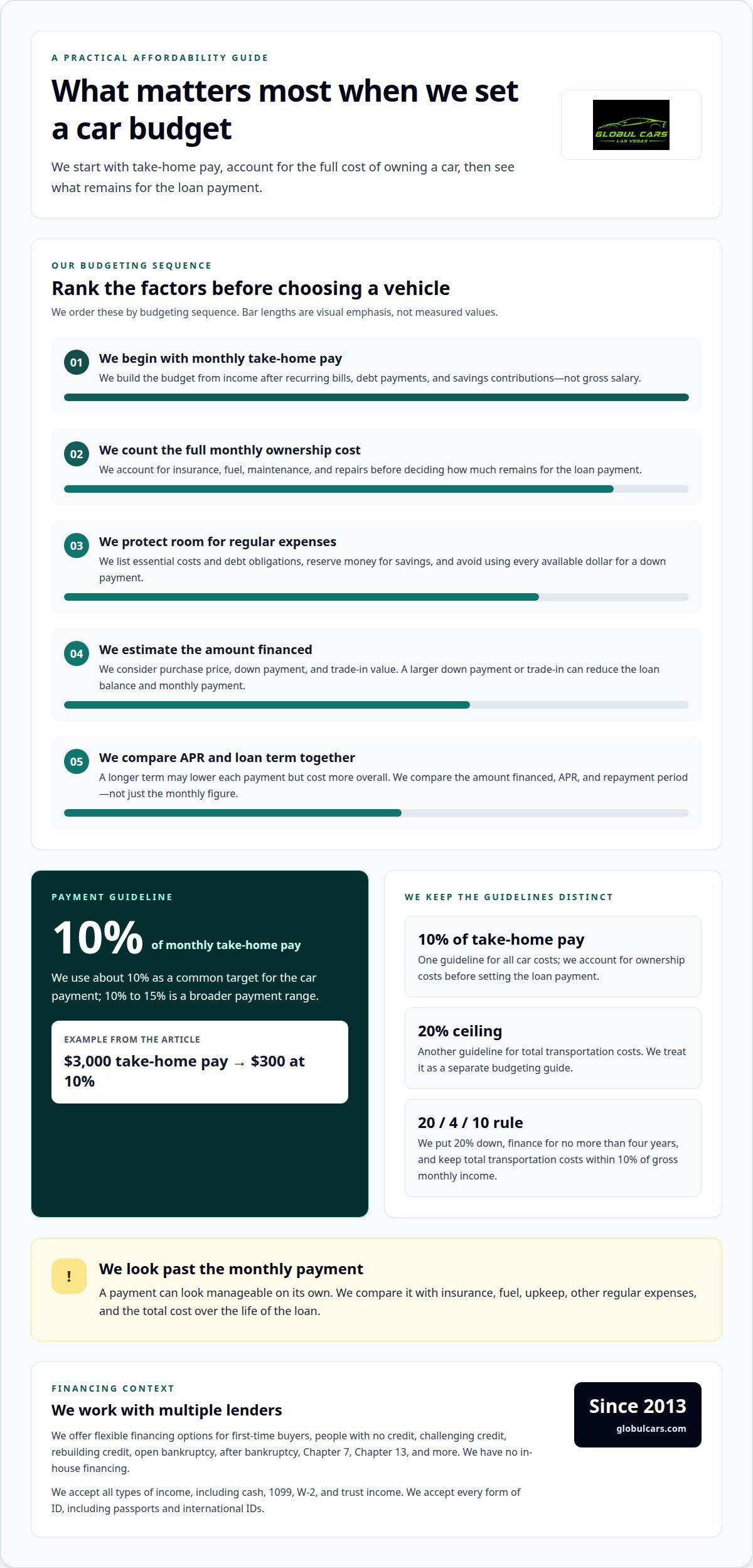
Using monthly take-home pay to set a car budget
Base your car budget on monthly take-home pay, then account for existing bills, savings, and transportation costs. To answer how much car you can afford on your salary, start with the money you actually receive, not your gross annual pay.
Estimating Costs From Take-Home Pay
Take-home pay is income remaining after payroll deductions, making it a practical starting point for budgeting. The 50/30/20 rule divides income among needs, wants, and savings, helping you see how a car fits alongside other priorities.
For a clearer estimate, list monthly housing, food, debt payments, and savings contributions. Subtract those amounts from take-home income, then reserve money for insurance, fuel, maintenance, and repairs. The remainder helps you set a payment limit before considering an auto loan.
Examples show how budgets change with income.
Car Expenses as a Share of Income
A car-cost share compares monthly transportation spending with take-home income. A useful guideline is to keep total transportation costs, including the loan, insurance, fuel, and maintenance, within a manageable share of take-home income.
Other advice is more conservative, suggesting all car costs stay within 10% of take-home pay. These figures are different budgeting approaches, not a single universal limit. Choose a target that leaves enough for bills and savings, especially if debt payments already take a large share of income.
Apply your chosen percentage to monthly take-home pay, then subtract costs beyond the loan. For example, insurance and fuel reduce the amount available for a monthly car payment. If expected ownership costs exceed your target, lower your payment budget or consider a less expensive vehicle.
An affordability calculator can help you compare estimated payments with your budget. Enter a preferred payment, down payment, loan term, and expected interest rate. Treat the result as one part of the calculation, then account separately for insurance, fuel, upkeep, and repairs.
Test your budget before buying by setting aside the expected total cost of ownership for a few months. Keep paying regular expenses and saving as usual. If the test strains your budget, adjust the planned payment before taking on an auto loan.
Use the 20% transportation guideline as a ceiling, not a spending goal. Your debts, savings needs, and monthly expenses determine how much of that share is truly available. A lower payment target can preserve more flexibility for unexpected costs.
Bank, credit union, and dealer financing
Bank, credit union, and dealership financing offer different routes to an auto loan. Compare the full offer, including APR, loan term, amount financed, and total repayment, rather than choosing by monthly payment alone.
A bank may offer financing directly to its customers, while a credit union provides loans through its membership. A dealership can arrange financing with a lender as part of a vehicle purchase. In each case, the lender evaluates information such as credit history, income, debts, and the vehicle being financed.
These routes can differ in how they assess an application and structure loan terms. A credit score below 680 may limit financing options, but it is one part of the review. Income, existing obligations, down payment, and loan amount also shape affordability. A buyer with challenging credit should focus on the full terms offered, not assume one score tells the whole story.
Compare offers using the same vehicle price and down payment. Check the APR, loan term, amount financed, and total interest side by side. A longer term can mean lower monthly payments but may increase the total cost. A shorter term generally means higher monthly payments, so make sure the amount fits your household budget.
Review the full written terms before agreeing. Consider whether the payment leaves room for insurance, fuel, maintenance, repairs, and savings. If an offer makes the monthly payment look manageable only by extending the loan, compare its total repayment with a shorter-term option. The lowest monthly payment is not automatically the least expensive choice.
A car affordability calculator can help you test different loan amounts, down payments, rates, and terms. Use the same inputs for each financing option, then compare the estimated payment and total interest. Calculator results are for informational purposes only; estimates may exclude taxes, registration, lien, and other government-imposed costs tied to a vehicle sale or financing.
Your financial situation can change, so choose a loan payment that leaves a workable margin after regular expenses. Four-year financing plans used to be common, while available terms now vary by lender and vehicle. Focus on a payment and term that suit your budget, rather than extending repayment simply to qualify for a higher-priced car.
Use the payment limit you established from take-home pay as your comparison point. Then review the lender’s APR, term, and total repayment against that limit. A clear side-by-side comparison helps show which financing route fits your budget, not just which one offers a lower monthly payment.
Globul Cars: Vehicle Financing Solutions
Globul Cars offers Vehicle Financing Solutions for buyers comparing cars with a realistic budget and financing needs. We work with multiple lenders and offer flexible options for first-time buyers, people with no credit, challenging or rebuilding credit, and buyers with open or past bankruptcy, including Chapter 7 and Chapter 13. We don’t provide in-house financing.
When you’re ready to explore a pre-owned vehicle, we offer options including Mercedes-Benz, BMW, and Land Rover. We accept all types of income, including cash, 1099, W-2, and trust income, as well as every form of ID, including passports and international IDs.
Contact Globul Cars to discuss financing and find a vehicle that fits your budget.
Take the next step with a budget that feels workable
Your budget is a tool for making a confident choice, not a target you need to stretch. Keep your preferred payment and full ownership costs in view as you consider which vehicle suits your priorities. If you’re still weighing how much car you can afford on your salary, use your budget to guide the conversation and compare options at a pace that works for you.
Globul Cars offers vehicle financing solutions and pre-owned Mercedes-Benz and BMW in Las Vegas. Explore these options with your financing needs in mind. The right next step respects both the car you want and the budget you’ve set.
Contact Globul Cars about your budget, and we’ll help you explore your options. A clear plan can make your next decision feel more manageable.
Frequently Asked Questions
How Much Car Can I Afford?
Start with a monthly payment that fits your take-home pay and leaves money for other goals. A common starting target is about 10% of net monthly income for the payment, with 10% to 15% as a broader range. To estimate how much car you can afford on your salary, work backward from that payment and account for insurance, fuel, and upkeep before settling on a purchase budget.
Treat this as an example, not a universal quote. A different APR, down payment, or repayment period changes the payment. Taxes, registration, lien, and other government-imposed costs can also affect the total amount due.
How Much Should I Pay for a Second Hand Car?
Choose a used-car budget that leaves room for condition-related costs, not just the purchase itself. The average used-car price in 2025 was just over $25,000, but a specific vehicle’s value depends on its age, mileage, condition, and market demand. Compare similar models to understand pricing, then factor potential repairs, insurance, and maintenance into the amount you’re comfortable spending.
How much should I spend on a car if I make $100,000?
One estimate for a $100,000 annual income puts a possible monthly car payment between $583 and $874. These figures illustrate why salary alone doesn’t set a vehicle budget. Your take-home pay, debts, savings plans, and ongoing car expenses determine what fits your own finances.
How much should my car payment be?
A practical starting point is to keep the payment near 10% of monthly take-home pay. For example, a person bringing home $4,500 monthly might target a $450 car payment. Before choosing that amount, account for insurance, fuel, maintenance, and repairs. If those costs would crowd out essential bills or savings, set a lower payment limit and adjust the vehicle budget accordingly.
A vehicle around $50,000 may be a rough price reference for someone earning $100,000 annually. Kelley Blue Book suggests a vehicle might cost roughly half a buyer’s annual salary, but that shortcut doesn’t account for every household’s expenses. Compare the payment and ownership costs with your take-home budget, then choose a vehicle that leaves room for debt payments and savings.
What percentage of income should go toward a car payment?
Common guidance places the car payment at about 10% of take-home pay, with a broader range of 10% to 15%. Total transportation costs use a different measure: one guideline caps them at 20% of net monthly income. Don’t treat these as the same limit. A payment target covers the loan, while total costs include insurance, fuel, maintenance, and repairs.
How do car loan interest rates, loan terms, and down payments affect affordability?
A higher interest rate increases borrowing costs, while a longer loan term can reduce each monthly payment but raise the total interest paid. A down payment reduces the amount financed, which can lower the payment and total interest. Compare loan offers using the APR, amount borrowed, term, and total repayment. Then check that the payment fits alongside the vehicle’s other ownership costs.


