

We know a Honda Civic’s mileage can raise questions when you’re weighing a used Honda Civic for sale near me in Las Vegas. Civics tend to last more than 200,000 miles, and some pass 300,000 with proper care, routine maintenance, and good driving habits. Mileage matters, but a car’s history and condition also help show how much life it may have left.
We understand you’re looking for dependable transportation, manageable fuel use, and safety features that suit your needs. The right Civic depends on its model year, engine, trim, mileage, and maintenance history.
We’ll cover Civic longevity, fuel economy, safety features, and practical ways to assess nearby listings. Use these details to narrow your options beyond the odometer reading.
Key Takeaways
- Compare engine choices with your driving needs: a 2023 Civic with a 2.0L engine was listed at 31 mpg city and 40 mpg highway, with 158 hp.
- Look beyond the odometer when weighing a used Civic, and use its condition and vehicle history to guide your assessment.
- Compare safety features by model year and trim so you can focus on the equipment that matters to you.
- Review nearby listings by distance and vehicle details to narrow down which options are practical to see.
- Learn how flexible financing through multiple lenders may support buyers with different credit backgrounds.
Civic fuel economy and engine options
We compare fuel economy and engine details by model year because Civic listings can differ. A 2023 Honda Civic with a 2.0L engine was listed at 31 mpg city and 40 mpg highway.
Fuel Economy
We use city and highway ratings as separate comparison points. The Civic’s combined fuel economy can exceed 30 miles per gallon, but listed ratings aren’t a promise of what every driver will achieve. The mileage disclaimer refers to 2024 EPA mileage ratings. For your comparison, we suggest focusing on the rating that best matches your usual driving.
Frequent stop-and-go trips make city fuel economy especially relevant, while longer freeway drives make highway figures useful. Driving habits, maintenance, and the individual car’s condition also affect real-world fuel use. These factors help explain why two Civics with similar listed ratings may use fuel differently.
Engine Options
We look at the exact engine listed for each vehicle rather than assuming every Civic shares the same setup. The 2023 Civic 2.0L I4 engine was listed with 158 horsepower. Civic descriptions also include a four-cylinder turbo engine, so check the specific listing to see which engine it identifies.
Transmission details matter, too. The Civic is available with a Six-Speed Manual Transmission (6MT). We recommend comparing the listed transmission alongside engine details and fuel economy. That gives you a clearer picture of how each vehicle may suit your daily driving and preferences.
As we compare listings, we match the model year, engine, transmission, and fuel economy figures. This avoids applying one model’s ratings to every Civic. A listing that identifies a 2.0L engine, for instance, gives you a specific configuration to compare with your driving needs. We also note whether the listing names a 6MT or another transmission, since that affects which vehicles fit your preferences.
- Compare each Civic’s listed engine with its fuel economy figures.
- Use the city or highway rating that fits your regular route.
- Check the listing for a 6MT or another stated transmission.
Use these details to build a practical shortlist, then assess each car on its own merits. Matching engine and transmission details to your driving habits helps you compare vehicles beyond the Civic name alone.
How many miles can a Honda Civic last?
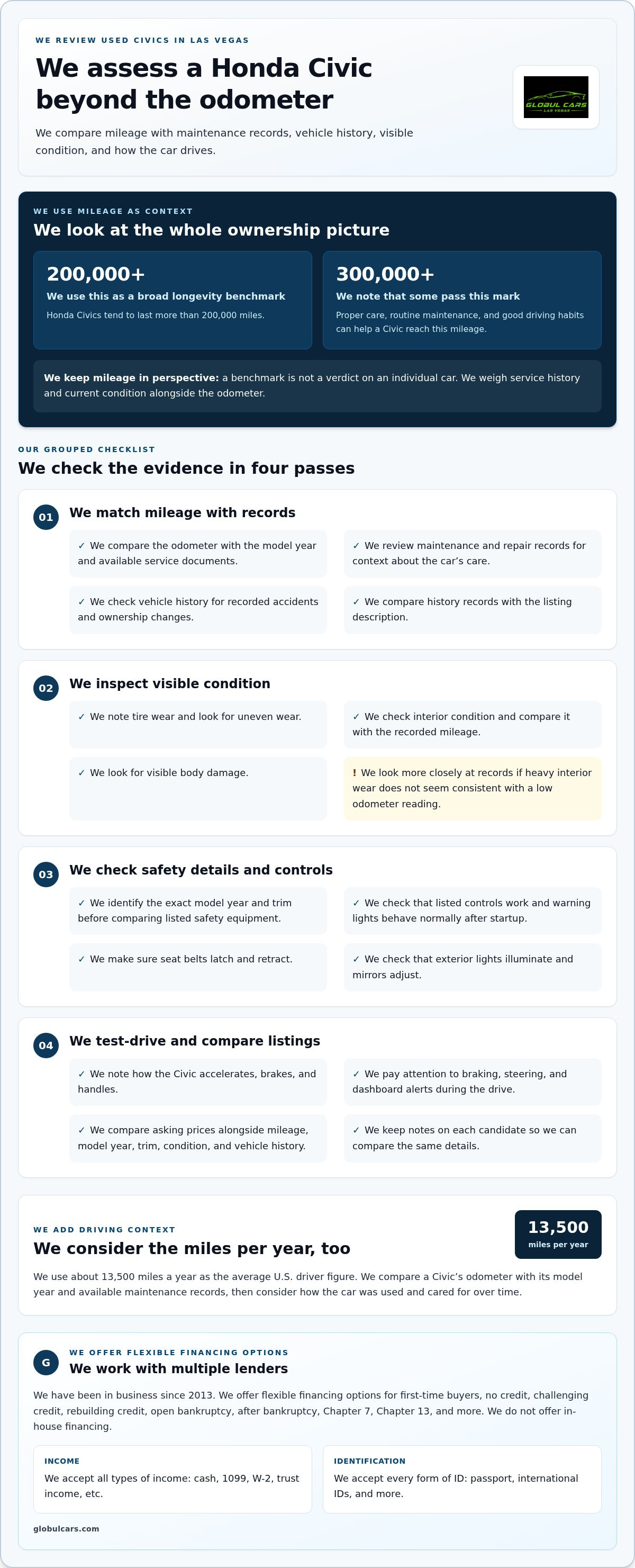
We use mileage as one part of a Civic’s history, not as a complete measure of its condition. Honda Civic cars tend to last more than 200,000 miles. Some drivers have passed 300,000 miles with proper care, routine maintenance, and good driving habits. Those benchmarks give context, but the service history and condition of the specific car matter when we assess a used listing.
The average U.S. driver covers about 13,500 miles a year. At that pace, reaching a high mileage would take many years. We compare a Civic’s odometer with its model year and available maintenance records. A reading makes more sense when considered alongside how the car was used and what care it received over time.
Start with the odometer, then review service documents for maintenance and repairs. During an in-person inspection, check tire wear, interior condition, and visible body damage. Compare the car’s wear with its recorded mileage. For example, heavy interior wear alongside a low odometer reading is a reason to look more closely at the available records.
Review the vehicle history for recorded accidents, ownership changes, and maintenance entries. Compare those details with the car’s condition and listing description. History records provide context about that Civic, while an inspection shows its current condition. Keep notes on each candidate so you can compare the same details rather than relying on memory.
- We compare odometer readings with model year and service history.
- We note visible tire, interior, and body wear.
- We test-drive the Civic and record how it accelerates, brakes, and handles.
- We compare history records with the listing and the car’s condition.
For Las Vegas listings, compare asking prices alongside mileage, model year, trim, condition, and vehicle history. A low odometer reading alone doesn’t explain price differences. Prices vary by vehicle, and you can request a quote for a specific listing. Compare similar Civics using the same details, then weigh each asking price against the available evidence about the car’s care and condition.
We treat 200,000 miles as a broad longevity benchmark, not a verdict on an individual car. Our next step is to compare records, condition, and how the Civic drives. That gives us a fuller basis for judging a listing than the odometer alone.
Civic reliability and safety features
A Civic’s reliability depends on the individual car, not just its model name. Maintenance, driving conditions, and past damage all affect its current condition. For a practical assessment, compare service records with what you can see and how the car drives. Give safety the same close attention: equipment and controls can vary by model year and trim.
Start with the listing’s exact model year and trim, then identify the safety equipment it describes. Don’t assume every Honda Civic has the same features. Compare listing descriptions and note which equipment matters for your regular trips around Las Vegas. During an inspection, check that the listed controls work and that warning lights behave normally after the car starts.
Next, check basic safety-related items in person. Make sure seat belts latch and retract, exterior lights illuminate, and mirrors adjust. Look for uneven tire wear or visible damage. During a test drive, pay attention to braking, steering, and dashboard alerts. These checks don’t replace a full assessment, but they can flag issues to investigate before you choose.
Vehicle history offers another view of reliability. A 2023 Honda Civic’s listed accident-free share was 80.7%. That figure describes the share of vehicles listed as accident-free in the market data; it does not establish the condition or safety of any single car. Review the history of the specific Civic you’re considering, then compare its records with visible repairs and the seller’s description.
- Match the listed safety equipment to the Civic’s year and trim.
- Test seat belts, lights, mirrors, and listed controls.
- Observe braking, steering, and dashboard alerts during a drive.
- Compare accident and maintenance records with the car’s condition.
A car’s records can also offer clues about its maintenance. Look for service entries that make sense alongside its age and use. Clear dates and descriptions help show what work was performed. If records show recurring repairs, consider how those patterns fit your needs and budget. A tidy interior alone doesn’t tell you how the Civic was maintained.
Use the same comparison for each candidate: note its model year, trim, listed safety equipment, history, and inspection observations. If two Civics have different trims, compare their stated equipment before deciding one has an advantage. Keep your notes specific to each car. This helps you assess reliability and safety without treating a model’s reputation as proof about an individual vehicle.
Choose the Civic whose records, equipment, and test-drive behavior best fit your priorities. An accident-free label or feature list can guide your review, but neither replaces examining the specific vehicle. A careful comparison gives you a clearer basis for deciding which car merits a closer look.
Listing locations and distances
When searching for a Civic in Las Vegas, location helps you plan which listings to compare in person. Start from a familiar place, such as home or work, and set a practical search area. A nearby listing may make a visit easier, but distance alone won’t tell you whether the vehicle suits your needs. Compare location with the Civic’s model year, trim, mileage, and other listed details.
Consider the address and distance together. The displayed distance may differ from the driving route across Las Vegas, so use a map to plan the trip. For example, compare the route from home and from work to a listing. This can help you group visits around the places you actually travel.
Use the same starting point and search settings for each listing, or distance comparisons may mislead you. If a search page sorts Civics by proximity, note the location used for sorting. Record each vehicle’s address, displayed distance, and route. This keeps a listing from becoming your first choice simply because it appears close on a screen.
- Set your search around a regular Las Vegas starting point.
- Compare the listing address with the route you would drive.
- Record distance alongside each Civic’s year, trim, and mileage.
- Group nearby visits when you have several vehicles to assess.
Before planning a visit, compare the listing details with its location information. A map pin shows the general area, while an address gives you a more useful route destination. If two listings seem similarly close, consider how each route fits your schedule and usual travel. Focus on practical convenience, not just the shortest displayed distance.
Las Vegas-area searches may include listings in different parts of the metro area. Search settings can narrow the results, but a small radius may exclude vehicles that fit your criteria. If the first results don’t offer enough suitable options, expand the area and compare the additional listings by route and vehicle details. This balances convenience with a broader selection.
For example, one Civic may be closer but have fewer listing details, while another farther away includes the model year, trim, and maintenance information you need. Compare what each listing tells you before deciding which one to visit. Distance helps organize your search, but it works best alongside information you can use to evaluate the car.
Keep a shortlist with each Civic’s location and the route from your chosen starting point. Add notes about what you want to examine at each stop. This makes it easier to organize your Las Vegas search and decide which listings merit an in-person look.
What fees, taxes, and registration costs apply when buying a used car in my area?
For a used-car purchase in Las Vegas, separate the vehicle’s asking price from taxes, registration expenses, and any transaction charges. The total depends on the specific sale and the costs included in its written breakdown. Review each line before comparing two Civics, because one advertised amount may include items another listing presents separately.
Review the written purchase breakdown and identify the vehicle price, taxes, and title or registration charges. Ask what each listed amount covers and whether it applies to the transaction. Keep optional products separate from required costs so you can compare the figures clearly.
Taxes depend on the transaction and applicable local rules. Don’t estimate them from another car’s paperwork. Review the tax amount in the purchase breakdown for the Civic you’re considering. If it changes after a trade-in or another transaction detail, check the revised breakdown before setting your budget.
Keep registration and title costs separate from the car’s price in your budget. Their amounts depend on the vehicle and registration details. Listing these costs individually, rather than combining them into a general figure, makes the total easier to understand and compare.
Use this checklist when reviewing the buyer’s paperwork:
- Identify the vehicle price and any taxes shown.
- Separate title and registration charges from dealer fees.
- Ask for a plain-language description of each listed charge.
- Mark optional products or services separately from transaction costs.
- Compare the final written total with the earlier estimate.
If two used Civics have similar asking prices, compare their written price breakdowns rather than relying on advertised prices alone. Check that you’re comparing the same items in each, including taxes and registration. If one estimate includes an optional product and the other doesn’t, separate that item before deciding which total fits your budget.
Keep the final price breakdown with the vehicle details, such as model year and trim. This helps you track which figures relate to which Civic. If an amount changes, compare the revised document with the earlier version and ask what changed. A clear breakdown helps you budget for the complete transaction, not just the advertised vehicle price.
Globul Cars: Vehicle Financing Solutions
Globul Cars offers Vehicle Financing Solutions for buyers considering a used vehicle. We work with multiple lenders and offer flexible financing options for first-time buyers, no credit, challenging credit, rebuilding credit, open bankruptcy, after bankruptcy, Chapter 7, Chapter 13, and more. We don’t offer in-house financing.
We accept all types of income, including cash, 1099, W-2, and trust income. We also accept every form of ID, including passports and international IDs. These options can help if financing is part of your plan, while vehicle condition, mileage, and history remain important parts of choosing a car.
Our inventory also includes pre-owned Mercedes-Benz, BMW, and Land Rover vehicles. Contact Globul Cars to discuss your vehicle financing needs and explore available options.
Choose the Next Step That Fits Your Search
Turn your shortlist into a clear plan: decide which vehicle details matter most, which trade-offs you can accept, and what you want to learn before choosing. If a used Honda Civic for sale near me remains your focus, have the specific listing in mind when discussing your next steps. A focused conversation can help connect your vehicle choice with your financing needs.
We offer vehicle financing solutions, and our inventory also includes pre-owned Mercedes-Benz and BMW vehicles. If your search changes, these give you other options to consider while keeping your priorities in mind.
Bring your questions and the details of the Civic you’re considering. We can help you explore the next step without pressure. Contact Globul Cars about Civic listings, and move forward at a pace that feels right for you.
Frequently Asked Questions
What should I look for when buying a used Honda Civic?
Compare the exact model year, trim, equipment, and paperwork before deciding. Make sure the vehicle identification number on the car matches its documents, and compare the seller’s description with the service records. If a listing says a feature is included, test its controls during your visit. Keep a short list of priorities, such as transmission type or safety equipment, to assess each Civic consistently.
What used Honda Civic listings are available near me?
Available Civic listings change, so review current Las Vegas inventory and compare each vehicle’s details. Globul Cars offers online inventory search by price, make, model year, and mileage. Use those filters to narrow your options, then look for a listing that identifies the Civic’s specific trim and location. A search for a used Honda Civic for sale near me is most useful when you compare current listings rather than rely on older results.
What are the prices of used Honda Civics near me by year, trim, and mileage?
Used Civic prices vary by vehicle, including its model year, trim, mileage, condition, and history. Compare listings with similar details rather than treating different model years as direct matches. Globul Cars displays vehicle and total prices on its listings. Contact the dealer to confirm the full out-the-door price. Keep the written price breakdown with the specific listing so you can compare totals accurately.
Which nearby dealerships and private sellers have used Honda Civics for sale?
In Las Vegas, dealership inventory and private-party listings are separate options to compare. Globul Cars is a local used-car dealership with online inventory search by make, model year, mileage, and price. For any Civic listing, compare the seller’s description with the vehicle’s documents and history. Note the seller, location, and vehicle details so you can distinguish similar listings.
What is the typical mileage and condition of local used Honda Civic listings?
No single mileage or condition describes every local Civic listing. Compare each odometer reading with the car’s model year, service documents, and visible wear. For example, worn seats alongside a very low odometer reading may warrant a closer look at the vehicle’s history. Note tire condition, interior wear, and any differences between the listing description and the car in front of you.
How can I check a used Honda Civic’s history, title, and accident records?
Match the vehicle identification number on the Civic with its paperwork and any history records you review. Compare recorded ownership, service entries, and accident information with the seller’s description. Look for missing or inconsistent details, such as a repair mentioned in the listing but absent from the available records. Keep copies of the documents you review, and rely on that vehicle’s records rather than assumptions about its model year.
What should I inspect and test-drive before buying a used Honda Civic?
Inspect the Civic in daylight, then test its controls and drive it on roads similar to your usual route. Check the lights, mirrors, seat belts, dashboard alerts, and visible tire wear. During the drive, pay attention to braking, steering, unusual sounds, and how the car responds. Afterward, compare any concerns with the listing and service records. Write down your observations while they’re fresh, especially if you’re comparing several cars.
What financing, warranty, and return options are available for used Honda Civics near me?
We offer vehicle financing solutions, and warranty options are available through GWC and Cornerstone. Review the written financing and warranty terms for your specific purchase; coverage and conditions depend on the documents. Don’t assume a return option applies unless it appears in the sale terms. We’re here to help you explore your next step. Give us a call or send us a message today and drive your next best car tomorrow!


