

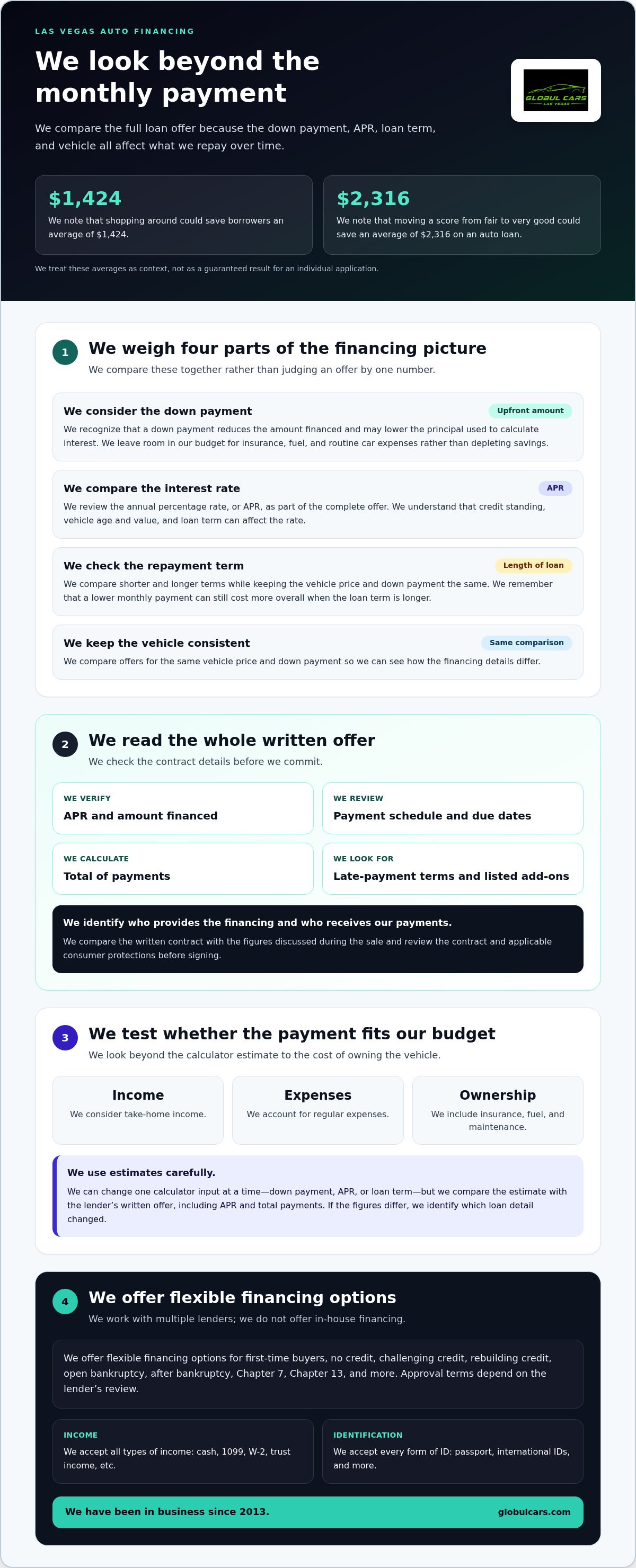
Shopping around for Las Vegas auto loans for bad credit could save borrowers an average of $1,424. Comparing offers matters because your credit, the vehicle, and the loan terms can affect what you pay over time. A low credit score doesn’t automatically end the search for a car loan.
If you’re concerned about a large down payment, a high interest rate, or being turned down because you have no credit history, those concerns are understandable. The details of a financing offer matter, so learn what lenders consider before choosing a vehicle or committing to payments.
This guide explains how down payments, interest rates, and loan terms work together, what pre-approval can tell you, and what options may be available to borrowers with bad or no credit in Las Vegas. You’ll also learn how to compare offers and approach your next step with a clearer view of your choices.
Key Takeaways
- Compare the full loan offer, not just the monthly payment; the down payment, interest rate, loan term, and vehicle all shape what you repay.
- Pre-approval can help you understand your financing options before choosing a car and make it easier to compare offers.
- Bad or no credit doesn’t automatically rule out financing; lenders may consider your overall application and income.
- Prepare to discuss your income, identification, and residency details, since documentation needs can vary with your situation.
- We work with multiple lenders and offer flexible financing options, but we don’t provide in-house financing.
Looking for a Bad Credit Car Dealer in Las Vegas?
When comparing Las Vegas auto loans for bad credit, find out who provides the financing and read the full agreement before signing. In-house financing and loans arranged through outside lenders work differently.
In-House and Buy Here, Pay Here Financing
With in-house financing, the dealership provides the loan. Buy here, pay here typically means the dealership sells the vehicle and collects payments directly. By contrast, a dealership may arrange financing through outside lenders, which set the approval terms. Ask who the lender is and who receives your payments.
Globul Cars works with multiple lenders rather than offering in-house financing. Before accepting an offer, compare the annual percentage rate, amount financed, payment schedule, total of payments, and late-payment terms. A lower monthly payment can still cost more overall if the loan term is longer.
For Nevada auto loans and dealer-arranged financing, review the written contract and applicable consumer protections before signing. Compare the APR, total payments, due dates, and any listed add-ons with the figures discussed during the sale.
Financing for Credit and Life Circumstances
Credit history is only one part of an application. Borrowers with bad, limited, or no credit can look for flexible financing options, while customers rebuilding after bankruptcy may need to explain their current circumstances. Chapter 7, Chapter 13, an open bankruptcy, and a completed bankruptcy are distinct situations, so provide accurate details about your case.
Divorce can change household finances or leave shared debts on a credit report. Before discussing a vehicle loan, prepare a clear picture of your current income, expenses, and obligations. Globul Cars offers financing options for challenging credit, no credit, rebuilding credit, open bankruptcy, and after bankruptcy. Approval terms depend on the lender’s review.
Personal references may support an application if requested, but they don’t replace accurate income and credit details. Provide each reference’s correct contact information and explain their relationship to you. Get permission before listing someone, and don’t describe a reference as a co-borrower unless they are applying for the loan.
Risks of Subprime and Buy-Here-Pay-Here Loans
Key risks include a costly rate, payments that strain your budget, or contract terms that differ from what you expected. With buy-here, pay-here financing, the dealership collects payments, so identify the payment recipient and find out how to access your account information. For any subprime offer, review the APR, total repayment, due dates, and consequences stated in the contract.
What risks should borrowers watch for in buy-here-pay-here loans and subprime auto financing? Focus on the total repayment obligation, late-payment terms, and any optional products added to the agreement. Request a copy of the contract and compare its figures with the offer before signing. A personal reference doesn’t guarantee approval or change the loan terms.
Guidance on down payments, interest rates, and loan terms
Compare the complete financing offer, not just the monthly payment. The down payment, interest rate, and repayment term all affect the total cost of a car loan.
Down Payments and Credit Improvement
A down payment reduces the amount you finance and may lower the principal used to calculate interest. Choose an amount that leaves room in your budget for insurance, fuel, and routine car expenses. Don’t deplete your savings just to make a larger upfront payment.
A down payment and credit improvement work differently: cash reduces the loan balance, while stronger credit may affect the rate offered. Raising a borrower’s score from fair to very good could save an average of $2,316 on an auto loan. Treat that as a reason to review your credit profile, not as a guaranteed result for one application.
One Nevada Credit Union says auto loan rates depend on credit standing, vehicle age and value, and loan term. It also says rates and repayment terms may vary when financing through a local dealership. Compare offers for the same vehicle price and down payment, then review the APR, amount financed, term, and total payments side by side.
There’s no single down payment requirement for every borrower or vehicle. The amount may depend on the lender’s terms, the vehicle’s value, and your overall application. Ask how your proposed down payment changes the amount financed and monthly payment. Check whether it affects any other listed terms, too.
Customized Payment Plans
A payment plan should fit your take-home income and regular expenses. Use an auto loan payment calculator to compare scenarios, changing one input at a time: down payment, APR, or loan term. For example, compare shorter and longer terms while keeping the vehicle price and down payment the same.
A calculator provides an estimate, not the full cost of owning a vehicle. Include insurance, fuel, and maintenance in your budget, then decide what payment is manageable. Compare the estimate with the lender’s written offer, including its APR and total of payments. If the figures differ, identify which loan detail changed.
To reduce the total cost or refinance a bad-credit car loan in Nevada, compare your current payoff balance and remaining term with the new offer’s APR, fees, and total payments. A lower monthly payment alone may not mean you pay less overall if the new term is longer.
Before accepting customized terms, check the due date, payment frequency, and total repayment amount in the contract. A plan that aligns with your pay schedule may help with budgeting, but the APR and term still affect how interest adds up. Compare the written offer, not just a calculator result.
Auto loan pre-approval
Pre-approval can help you understand potential financing terms before choosing a vehicle. Treat it as an initial estimate, then review the final agreement before signing.
Lenders for Bad-Credit Borrowers
Borrowers with challenging credit can compare offers from lenders that consider more than a credit score. Lenders may weigh income, existing debts, the requested loan amount, and vehicle details. Compare offers using the same vehicle price and down payment. Review the annual percentage rate, repayment term, monthly payment, and total payments, not just whether the application is approved.
Eligibility and Credit-Score Requirements
There’s no single credit-score threshold for every lender or application. A lender may assess your credit history alongside your income, monthly obligations, down payment, and the vehicle being financed. Provide accurate information about late payments, limited history, or past credit problems. Then ask which terms are available for your application and how each affects the total repayment.
Borrowers with credit scores below 620 who compared multiple auto loan offers could save an average of $2,966. That figure is an average, not a promised saving. Comparing offers can show whether a different APR or loan term changes the total amount you would repay.
Application and Lender Response
Start with a complete application and consistent details about your income, residence, and requested financing. If you’re shopping for a vehicle, choose a realistic price range so the requested loan amount fits your budget. A lender reviews your application and may request clarification or additional documents. Respond accurately and read the written offer carefully before deciding.
Pre-approval doesn’t replace a review of the final vehicle and contract. Compare the lender’s final APR, amount financed, payment schedule, and total payments with the earlier estimate. If a figure changes, identify the reason before signing. Keep a copy of the completed agreement and payment details for your records.
Required Income and Identity Documents
Prepare clear income and identity information before starting an application. We work with income from cash, 1099, W-2, trust income, and other sources, and accept every form of ID, including passports and international IDs. Lenders may have their own documentation needs, so provide accurate details and organize records that support your application.
Residency information can help a lender assess an application and prepare its paperwork. Enter your current address consistently, and keep your income details aligned across forms. If your income comes from more than one source, such as W-2 wages and 1099 work, describe each source clearly rather than combining them into one unexplained amount.
A car loan may help build credit if the lender reports account activity and you make payments on time. Before borrowing for that purpose, check whether the lender reports payments. Set reminders for each due date and contact the lender promptly if your budget changes. Consistent payments matter, but the loan should still fit your finances.
Auto loans for borrowers with bad or no credit
Bad credit and no credit history are different starting points for an auto loan. A record of missed payments gives lenders past account behavior to review, while a thin file provides less borrowing history. In either case, compare the complete offer and choose a vehicle that fits your budget.
The cost difference can be substantial. On a $30,000 car loan, a borrower with bad credit could pay over $14,000 more in interest than a borrower with excellent credit. That comparison shows why the APR and loan term deserve attention alongside the monthly payment. Review each written offer before deciding.
Auto loan offers to borrowers with bad credit average $9,488 less than offers made across all credit bands. Treat that figure as context, not an individual approval amount. For your own application, compare the amount financed, APR, repayment term, and total payments. A smaller loan may also help keep the monthly obligation manageable.
No credit history isn’t the same as a record of late payments. If you’re new to borrowing, prepare a clear account of your income and recurring expenses. For example, list regular monthly bills beside your take-home income before choosing a vehicle. This budget can help you decide what payment leaves room for other needs.
Start with the vehicle, not just the amount you can finance. Compare available inventory by the price you can manage, then consider how your choice affects the amount borrowed. A lower-priced vehicle may require less financing, while a more expensive one can increase the principal and interest over the loan term. Keep your target budget consistent as you compare cars.
Your credit history may include details that need explanation, such as a paid account still reported as unpaid. Review your credit records before applying and note entries you believe are inaccurate. If a lender asks about a past hardship, answer clearly and keep dates and amounts consistent throughout your application. Accurate details can make the review more straightforward.
Compare more than one offer when possible. Borrowers with credit scores below 620 who compared multiple auto loan offers could save an average of $2,966. This is an average, not a guaranteed saving. Use competing written offers to compare APR, term, payment amount, and total repayment on the same vehicle and down payment.
Before signing, compare the final contract with the offer you chose. Check the vehicle price, amount financed, APR, payment schedule, and total payments. Ask about unfamiliar line items and ensure the contract reflects the agreed terms. A careful review helps you understand the obligation you’re accepting.
What income, residency, and identification documents do Nevada auto lenders require?
Auto lenders review documents to verify identity, income, and application details. Requirements vary by lender, so prepare accurate information before applying rather than assuming there’s one document list for every Nevada loan.
For income, organize records that clearly show where money comes from and how regularly you receive it. Examples include W-2 wages, 1099 work, cash income, or trust income. Keep figures consistent across your application and supporting records. If you have more than one income source, list each separately instead of combining them without explanation.
Income documentation can look different for different work arrangements. A W-2 employee may use recent pay information, while a contractor may gather records showing 1099 earnings. For cash income, keep a clear record of amounts and timing. These are preparation examples, not a universal lender checklist. Follow the specific document request attached to your application.
Residency details help match your application to your current living situation. Enter your complete address, including apartment or unit information, and use the same version on every form. If you’ve recently moved, gather records showing your current address. Don’t use a former address just because older financial records still show it.
Identification is another key part of an application. Have a current identity document ready and enter your legal name consistently. Passports and international IDs are examples of identification accepted in some financing situations. If your name differs across documents, such as after a legal name change, prepare an explanation and any supporting records requested by the lender.
Before submitting, use this practical review:
- Match your name and address across the application and supporting documents.
- Separate income sources, such as W-2 wages and 1099 earnings.
- Check that images or copies are readable and show complete information.
- Keep a copy of what you submit and note any follow-up request.
For example, a borrower with W-2 wages and cash income should avoid entering only one combined figure. Clearly identify each source and provide the records requested for that source. If a lender asks for an updated document, send the current version rather than an older record with different details.
Documents support a lender’s review, but they don’t replace accurate answers about your finances. Review each application field before submitting it, especially your income, address, and identity information. Keep requested records together so you can respond clearly if the lender needs a correction or another document.
Globul Cars: Vehicle Financing Solutions
Globul Cars has been in business since 2013. We offer Vehicle Financing Solutions through multiple lenders, not in-house financing. Our flexible financing options serve first-time buyers and borrowers with no credit, challenging credit, rebuilding credit, open bankruptcy, after bankruptcy, Chapter 7, Chapter 13, and more.
Choose a vehicle that fits your budget, then compare the lender’s APR, payment schedule, and total repayment amount. Globul Cars offers pre-owned Mercedes-Benz, BMW, and Land Rover vehicles to consider alongside your financing needs. Review the written offer carefully so you understand the loan before signing.
Contact Globul Cars or visit globulcars.com to discuss your options.
Take the Next Step Toward Your Car
As you compare Las Vegas auto loans for bad credit, focus on finding a vehicle and payment commitment that fit your plans. A clear conversation about your financing needs can help you consider which options may suit your situation.
Globul Cars offers vehicle financing solutions and pre-owned Mercedes-Benz and BMW vehicles. We can help you consider vehicle choices alongside your financing needs, so you can make your next decision with a clearer sense of what matters to you.
Bring your questions and take the time you need to understand the terms before moving forward. We’re ready to help you explore the next step at your own pace. Contact Globul Cars today, and move forward with confidence.
Frequently Asked Questions
What Las Vegas lenders offer auto loans for bad credit?
Globul Cars works with multiple lenders, including Capital One, American Heritage, Flagship, Western Funding, Westlake Financial, Credit Acceptance Corporation, and CPS. Each lender may have different approval criteria and offer terms, so compare the written details rather than treating one lender’s decision as universal. We don’t offer in-house financing. Review which lender is making the offer and who will service your account after the sale.
What credit score is needed for a car loan in Las Vegas?
No credit score guarantees approval across every Las Vegas lender. Each lender considers credit history alongside factors such as income, existing obligations, the amount requested, and the vehicle. A limited credit file also differs from a record of missed payments. Before applying, consider how much you need to borrow and prepare to explain any credit history details that may affect the review.
What are typical bad-credit auto loan APRs and fees in Nevada?
Bad-credit APRs and contract charges vary by lender, credit profile, vehicle, and repayment term, so a single typical rate can mislead. Compare the APR and total of payments on each written offer. Review every contract line item and ask what it means before signing. Focus on the complete repayment obligation, not just the monthly amount, and distinguish lender charges from optional products.
How much down payment is usually required for a bad-credit car loan in Las Vegas?
There’s no fixed down payment for every bad-credit car loan in Las Vegas. A lender’s decision may reflect your application, the vehicle’s value, and the amount you want to finance. Ask how changing your upfront contribution affects the amount borrowed and proposed terms. Set aside enough for the down payment while accounting for other vehicle ownership and maintenance costs.
Can you get a bad-credit auto loan in Las Vegas with no down payment?
A no-down-payment loan may be available if a lender approves financing the full eligible amount, but that isn’t guaranteed for every borrower or vehicle. With no upfront contribution, you finance more of the purchase, which may affect the payment and total interest. Compare the offer with one that includes a down payment, using the same vehicle and loan term, before deciding.
How do Las Vegas credit unions, banks, dealerships, and online lenders compare for bad-credit car loans?
Lenders differ in how they review applications and present offers. A credit union or bank makes its own lending decision, while a dealership can work with multiple lenders; online lenders process applications through digital channels. Compare offers for the same vehicle using the APR, repayment term, total payments, and required upfront contribution. A like-for-like comparison can show whether a lower payment comes with a longer term.
How can you get preapproved for a bad-credit auto loan in Las Vegas?
Start with a complete application and a realistic borrowing target. Enter your income and housing details consistently, and have identity and income records ready if requested. When you receive an offer, note the lender, amount, APR, term, and any conditions. Treat pre-approval as a starting point, then compare the final written contract with those terms before agreeing to the loan.


