
A clean-looking Camaro can still have a complicated past. When considering a used Chevy Camaro in Las Vegas, review its vehicle history report, compare the VIN and odometer reading with the car and its records, and look for reported accidents, damage, theft, ownership changes, and maintenance gaps. Use those records alongside an in-person inspection before deciding.
It’s easy to focus on trim, color, or performance, but a car’s history can shape what to expect after purchase. A report is a useful starting point, not the whole picture, so compare its details with maintenance paperwork and the vehicle’s condition.
Review accident and damage records, check theft and ownership history, assess mileage, and make sense of maintenance information. Then use what you find to identify unanswered questions and decide whether the Camaro fits your needs.
Key Takeaways
- Compare the Camaro’s reported ownership and mileage with its records and the condition you observe.
- Learn how model year and trim can affect asking prices, and what to compare before judging an offer.
- Use a focused inspection to spot signs of past damage and condition issues that deserve closer attention.
- Understand which factors can influence Camaro repair costs and Nevada’s buying and registration steps.
- Explore how vehicle financing solutions may help you plan your next step after reviewing the car’s history.
Ownership, mileage, and maintenance history
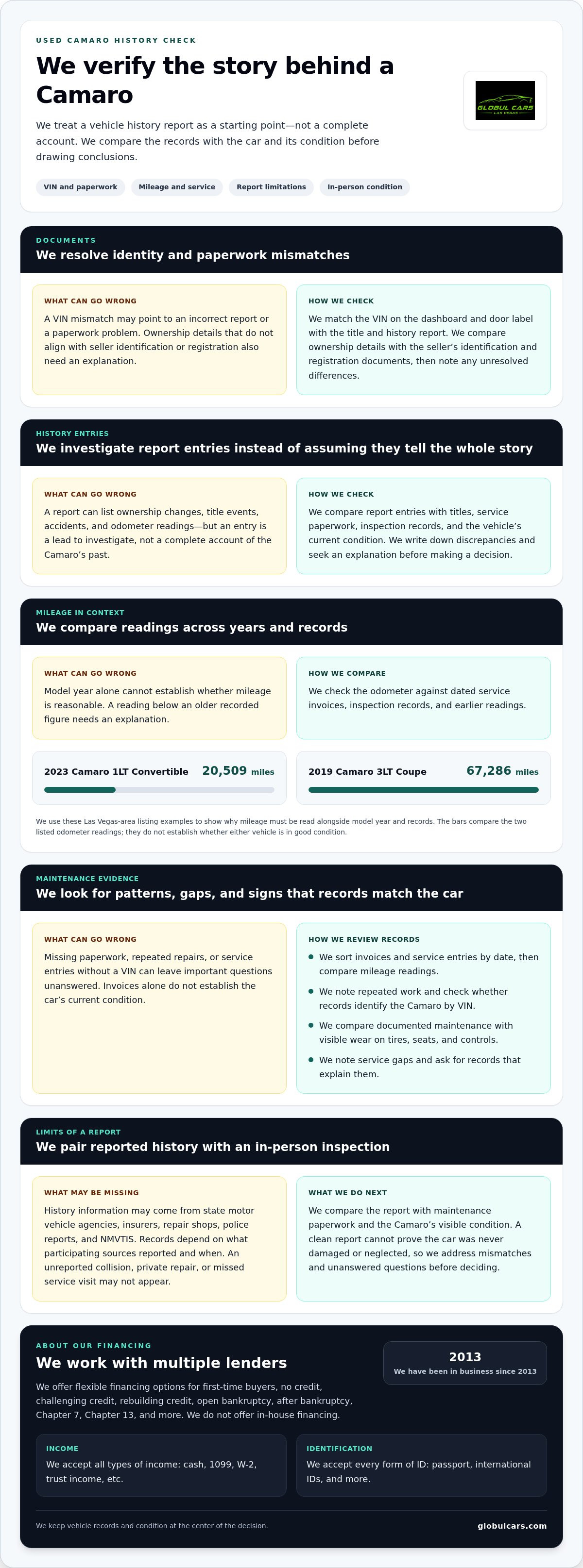
Start by matching the Camaro’s vehicle identification number, or VIN, across its dashboard, door label, title, and history report. A mismatch may point to an incorrect report or a paperwork problem. Compare the title’s ownership details with the seller’s identification and registration documents. Then review the report for ownership changes, title events, reported accidents, and odometer entries. Treat each entry as a lead to investigate, not a complete account.
We assess mileage in context, not by the odometer alone. Las Vegas-area listings have included a 2023 Chevrolet Camaro 1LT Convertible with 20,509 miles and a 2019 Chevrolet Camaro 3LT Coupe with 67,286 miles. These examples show why model year alone can’t establish whether mileage is reasonable. We compare the odometer with dated service invoices, inspection records, and earlier readings. A reading below an older recorded figure needs an explanation.
Vehicle-history information may come from state motor vehicle agencies, insurers, repair shops, and police reports. The National Motor Vehicle Title Information System, or NMVTIS, is another resource. Records depend on what participating sources reported and when. An unreported collision, private repair, or missed service visit may not appear. A clean report therefore can’t prove that a Camaro has never been damaged or neglected.
We use a consistent process to assess maintenance:
- Sort invoices and service entries by date, then compare each mileage reading.
- Look for repeated work, such as the same repair appearing more than once.
- Check whether records identify the Camaro by VIN, rather than just its model.
- Compare documented maintenance with visible wear on tires, seats, and controls.
- Note gaps and ask the seller for records that explain them.
Use maintenance paperwork to identify patterns, but don’t treat it as a substitute for an inspection. An invoice may show that a repair occurred without describing the car’s current condition. Compare its date and mileage with later records, and look for the same issue appearing again. If you can’t interpret listed work or parts, ask a qualified mechanic how those details relate to the car’s present condition.
Keep a written record of mismatches before making a decision. Note the VIN, odometer reading, report entries, title details, and missing service periods. A difference between records may have a straightforward explanation, but resolve it before proceeding. Use the combined picture, not one report field, to assess ownership, mileage, and upkeep. If the documents and the Camaro’s condition tell different stories, pause and address the discrepancy first.
The Las Vegas-area used Chevrolet Camaro search displayed 631 vehicles, giving buyers listings to compare with the car’s paperwork and condition. The page reports an overall Chevrolet Camaro user rating of 4.7 out of 5 from 1,394 reviews; that figure describes user ratings, not the history of any individual vehicle. Treat it as general context, and base an ownership decision on the specific Camaro’s records, mileage consistency, and inspection findings.
What are current used Chevy Camaro prices in Las Vegas by year and trim?
Compare Camaros by model year and trim before judging an asking price. These figures describe averages, not guaranteed prices for individual cars. A used Chevy Camaro in Las Vegas may differ from its year’s average because of trim, condition, mileage, and history.
We use these figures as comparison points, not as a ranking of the best deal. The 2021 average is higher than the listed 2023 and 2024 averages, but that difference alone doesn’t explain why. The figures don’t show which trims, mileage ranges, or conditions shaped each average. We compare specific listings with similar details before drawing conclusions about value.
Compare trim carefully, too. Two Camaros from the same year may have different equipment and performance configurations. Match an LT with another LT, or an SS with another SS, rather than treating every Camaro as equivalent. Compare coupes with coupes and convertibles with convertibles. A used Chevy Camaro in Las Vegas with a different body style or trim may not be a useful comparison, even if both cars share a model year.
Build a comparison table before viewing cars. Include model year, trim, body style, mileage, asking price, and equipment that matters to you. Then compare vehicles with similar details. If one car’s asking price differs from comparable listings, look at its condition and history for context. A price difference is a prompt for investigation, not proof of a problem or a bargain.
- We keep each model year in its own comparison group.
- We match trim and body style before comparing advertised prices.
- We consider mileage, service records, and visible condition together.
- We check whether listed equipment matches our priorities.
- We use the average as context, then assess the specific car.
Remember that an average describes a group, while an asking price applies to one vehicle. It can’t account for every listing difference, such as damage history, maintenance documentation, or equipment. Review the listing and inspect the Camaro before deciding whether its price fits its condition. That keeps your comparison focused on the car you’re considering, not only its model-year average.
What should I check when inspecting a used Chevy Camaro before buying?
Inspect the Camaro in daylight, on level ground, before starting the engine. Walk around the body and compare panel gaps, paint shade, and bumper alignment. Look for cracked lamps, chipped glass, uneven tire wear, and moisture inside the cabin. Check that the doors, hood, and trunk operate smoothly. On a convertible, operate the top and inspect its fabric, seals, and movement. Examine lower panels closely, since a fresh wash can obscure surface details.
Under the hood, look for fluid leaks, damaged hoses, loose wiring, or signs of recent cleaning around the engine. Start the car and watch the dashboard lights. Listen for unusual knocking, rattling, or squealing, and note exhaust smoke or strong fuel or burning smells. Warning lights should illuminate during startup and then go out as expected. Ask a mechanic to explain any visible concern before judging its seriousness.
During a test drive, check the Camaro’s controls and handling on familiar Las Vegas streets. Begin with gentle acceleration and braking, then assess the car’s response at different speeds. Notice pulling, vibration, delayed gear changes, or noises over bumps. Test the steering, parking brake, turn signals, air conditioning, windows, and infotainment controls. Choose a route with turns, stops, and smooth pavement, while keeping your attention on traffic.
- We inspect all four tires for uneven wear, visible damage, and mismatched brands.
- We listen for grinding or squealing while checking how the brakes respond.
- We test seat belts, mirrors, lights, horn, and dashboard controls individually.
- We look beneath the car for fresh drips or damaged exterior components.
- We confirm that both keys and any listed accessories operate correctly.
Bring in a qualified mechanic when you need a closer assessment. A lift can reveal underbody damage or leaks that aren’t visible from the pavement. Ask the mechanic to inspect the suspension, brakes, steering, cooling system, and drivetrain. Request clear explanations of findings, especially when a symptom could have several causes. Keep the written inspection notes alongside the seller’s description and service paperwork.
Finally, compare your observations with the advertised equipment. If the listing describes a feature, test it directly. For example, confirm that a convertible top opens and closes rather than relying on photographs. Record concerns and ask for a specific explanation before moving forward. A careful inspection combines a walkaround, road test, and mechanic’s assessment. These steps help distinguish cosmetic wear from issues that could affect the car’s use.
What are common reliability problems and repair costs for used Chevy Camaros?
Separate potential trouble spots from proven defects. Without service records specific to the model year, don’t assume every Camaro shares the same reliability problem. Instead, use the inspection to check the engine, transmission, cooling system, brakes, suspension, and electrical controls. A warning light, fluid leak, rough shift, or repeated repair entry deserves diagnosis. The cause matters: one symptom can point to different repairs, with different parts and labor needs.
Start with the engine and cooling system. Look for fresh fluid beneath the car, visible residue around engine components, or unusual smells after a drive. Watch the temperature gauge during normal operation and note any warning lights. Listen for persistent knocking, rattling, or squealing at startup and idle. These observations don’t identify a failed part by themselves. They give a mechanic specific symptoms to investigate and compare with the Camaro’s service paperwork.
Next, assess how the Camaro shifts, stops, and rides. During a road test, note delayed or rough gear changes, vibration, pulling, and noises over bumps. Check whether braking feels consistent and steering responds smoothly. Uneven tire wear may point to an alignment or suspension concern. Test the windows, lights, climate controls, and dashboard functions. Record each symptom, including when it appears, such as during startup, braking, or turning.
- Match each warning light or noise with the mechanic’s diagnostic findings.
- Ask whether a repair addresses the underlying cause or only a symptom.
- Compare the inspection findings with invoices and repeated repair entries.
- Request a written estimate that separates parts, labor, and recommended work.
- Prioritize safety-related repairs before cosmetic or convenience work.
Repair costs depend on the diagnosed fault, parts required, labor involved, and whether related components also need attention. For example, a brake concern could involve worn parts, a fluid issue, or another cause. A transmission complaint needs diagnosis before anyone can estimate the work. A written estimate should identify the repair, parts, labor, and any additional work separately. That detail makes estimates easier to compare and shows what drives the total.
Use inspection findings to assess the Camaro’s likely upkeep, not to predict a fixed repair bill. Ask the mechanic to explain urgent issues, upcoming maintenance, and items that can wait. Consider those findings alongside the service history and your planned budget. A Camaro with a clear diagnosis and documented repairs is easier to evaluate than one with unexplained symptoms. Treat repeated warnings, unresolved leaks, and recurring repair entries as reasons to seek a closer assessment before deciding.
What Nevada taxes, registration fees, and emissions requirements apply when buying a used Camaro in Las Vegas
Before signing, review a written buyer’s order that separates the Camaro’s sale amount from taxes, title charges, registration charges, and other line items. Don’t treat one combined total as a clear explanation. Ask what each charge represents and which office or transaction it relates to. Keep the order alongside the final sale documents so you can compare the figures before completing the purchase.
Nevada taxes and vehicle charges depend on the details of the sale and registration. The buyer’s order should show how the amount due is calculated and identify each charge by name. Review any trade-in or other transaction details shown on the paperwork. If a line is unclear, ask for its calculation in writing. This gives you a specific record to compare with your final documents.
Registration paperwork is a separate part of the process. Check that the Camaro’s VIN, model information, and ownership documents match across the sale paperwork and title. Confirm which registration steps apply to your address and vehicle with the Nevada Department of Motor Vehicles. Keep the title documents, bill of sale, and any temporary registration paperwork together. Don’t assume a seller’s explanation replaces documents issued for the transaction.
Emissions requirements can depend on where the Camaro will be registered and the vehicle’s details. For a Las Vegas-area purchase, identify the registration address first, then use Nevada DMV guidance to determine whether an emissions test applies. Clark County information may also clarify local testing procedures. Don’t infer a Camaro’s testing status from its trim, engine, or model year alone. Use the vehicle’s identifying details when reviewing requirements.
- Match the VIN on the Camaro, title, and buyer’s order.
- Ask for an itemized breakdown of taxes and registration charges.
- Confirm the registration address used for the transaction paperwork.
- Review Nevada DMV emissions guidance for that vehicle and address.
- Keep receipts, title documents, and inspection paperwork together.
Before finalizing the purchase, compare the written charges with the documents you receive. Check that the sale amount, Camaro identification, and registration details stay consistent. Save receipts for any tax or registration payment. If an emissions test applies, keep its paperwork with the vehicle records. These steps help prevent confusion later and make it easier to resolve a mismatch in a charge or document.
Make this paperwork review part of your purchase checklist, not an afterthought. A clear buyer’s order, matching VIN, and correct registration details give you a practical record of the transaction. Once you understand the listed charges and any emissions step tied to your registration, you can make a better-informed decision about proceeding with the Camaro.
Globul Cars: Vehicle Financing Solutions
Globul Cars offers Vehicle Financing Solutions for buyers considering their next vehicle. We work with multiple lenders and offer flexible financing options for first-time buyers, no credit, challenging credit, rebuilding credit, open bankruptcy, after bankruptcy, Chapter 7, Chapter 13, and more. We don’t provide in-house financing. Instead, we help connect buyers with lender options suited to their circumstances.
We accept all types of income, including cash, 1099, W-2, and trust income. We also accept every form of ID, including passports and international IDs. If you’re comparing financing paths after reviewing a Camaro’s history and condition, these details can help you prepare for the next step. Contact Globul Cars to discuss vehicle financing solutions.
Choose Your Next Step With Confidence
Once you’ve found a Camaro worth considering, make your next move with the full picture in view. Decide what matters most, whether that’s the car’s condition, its history, or how you’ll arrange the purchase. If you’re still weighing options for a used Chevy Camaro in Las Vegas, compare your priorities before committing.
We offer Vehicle Financing Solutions, along with a wide selection of other quality pre-owned vehicles for buyers considering different options. The right path depends on the vehicle you choose and the financing approach that fits your circumstances. A focused conversation can help you understand the next step without rushing your decision.
Reach out to contact Globul Cars to discuss your options. We’re here to help you move forward thoughtfully and choose a direction that feels right.
Frequently Asked Questions
What is the typical mileage and condition of used Camaros in Las Vegas?
There isn’t one mileage or condition that represents every used Camaro in Las Vegas. Compare a car with others of a similar model year and trim, then consider how its mileage matches its visible wear and maintenance records. For example, heavily worn pedals or a tired driver’s seat may deserve closer inspection alongside a low odometer reading. A mechanic’s inspection can help distinguish ordinary wear from issues that may affect the car’s use.
How can I check a used Camaro's vehicle history, title, accident, and recall records?
Use the Camaro’s VIN to check its history, title information, and open recalls. Compare the VIN on the dashboard with the title and report, then review the title status and reported accident entries. For recalls, enter the VIN in the National Highway Traffic Safety Administration’s recall lookup and review any listed actions. Keep the results together and compare them with the seller’s paperwork. A recall record and an accident-history report answer different questions, so check both.
What used Chevy Camaro models are for sale in Las Vegas, NV?
Listings include a 2015 Camaro 1LT Coupe, a 2019 Camaro 1SS Coupe, a 2019 Camaro 3LT Coupe, and a 2023 Camaro 1LT Convertible.


