

Yes, you can negotiate a dealer-arranged car loan rate. The dealer may offer a rate above the lender’s proposed buy rate, so ask how the APR was set and whether it can be lowered. To understand how to get a lower interest rate on a car loan, compare the APR, loan term, monthly payment, and total interest, not just the payment.
It’s reasonable to want a clear explanation before agreeing to financing. Your credit profile, income, down payment, loan amount, and repayment term can all affect an offer. We can help you understand why the rate presented at the dealership isn’t automatically your only option.
We’ll explain how dealer-arranged rates and markups work, how to negotiate with a competing offer, and how a shorter or longer loan term changes monthly payments and total interest. We’ll also cover what to weigh when comparing financing, so the full cost of the loan stays in focus as you consider terms for your budget.
Key Takeaways
- Ask whether the dealer-arranged rate can be reduced, and compare it with a financing offer you already have.
- Look beyond the monthly payment: use a loan calculator to compare APR, term, and total interest side by side.
- Understand how a dealer’s buy rate may differ from the rate offered to you, and use that knowledge when negotiating.
- Weigh the trade-off between a lower payment from a longer term and the interest that may add over the life of the loan.
- Compare the full loan terms before signing, not just the rate or the monthly amount.
1. Can I negotiate a car loan interest rate with the dealer?
Yes. In the United States, you can negotiate an interest rate offered through a dealer. The rate may reflect your credit score and history, income, down payment, loan amount, and loan term. Treat the first offer as a starting point, and look beyond the monthly payment. Ask whether the APR can be lowered, then compare the full offer with other financing options.
Before applying, review your credit reports for inaccurate account details, incorrect balances, or payments marked late by mistake. If you find an error, dispute it with the company that provided the information and the credit reporting company. Corrected information may affect how lenders assess your application. Keep records of the error and dispute so you can track its progress.
Next, focus on the parts of your credit profile you can influence. Make payments on time, reduce outstanding balances, and limit new credit applications. For example, lowering a $5,000 credit-line balance to $500 or $1,000 reduces the share of available credit being used. These steps can strengthen your profile, though rebuilding credit may take 18-36 months. Lenders also weigh income, down payment, requested amount, and repayment term.
Your credit score can affect the rate you qualify for. A car-sales manager answering this question says lenders may consider borrowers with scores under 700 higher risk. LendingTree reports that borrowers with bad credit pay auto loan rates a little over 14 percentage points higher on average than borrowers with excellent credit. We encourage you to review your credit before applying.
When you’re ready to compare offers, keep applications close together. According to the Consumer Financial Protection Bureau, consumers can generally keep auto loan rate shopping within a 14 to 45 day period so multiple lenders’ credit checks count as one inquiry. A prequalification using a soft credit check can help you review possible terms without affecting your score. We suggest asking which type of credit check is used before proceeding.
Refinancing may be another path if your credit has improved since you first financed the car. A new application can initially affect your credit score because it may involve a hard credit pull and a new loan. On-time payments after refinancing may help your score improve over time. We recommend comparing the new rate, remaining balance, term, and total interest before deciding whether refinancing supports your goal.
2. Are auto loan rates negotiable?
Yes. You can compare offers from banks, credit unions, and other lenders before choosing financing. We recommend gathering offers from at least three lenders, then comparing the same loan amount and repayment term. A lower monthly payment alone doesn’t prove an offer costs less. Check the annual percentage rate, payment schedule, loan length, and total interest together. Comparing offers and choosing the lowest rate can save borrowers more than $3,000 on average.
Start with preapproval so you have a written offer to compare with dealer-arranged financing. A bank or credit union may let you prequalify using a soft credit check, which doesn’t affect your credit score. Review the proposed APR, term, and any conditions. Preapproval gives you a reference point for negotiation, but compare final loan terms, not just an initial estimate.
A credit union loan can be a useful comparison alongside bank offers. Credit unions may use their own lending criteria, so don’t assume their offer will match a bank’s. Submit the same basic loan request to each lender, including the amount and term you want. Then compare the APR, required payment, and total interest. Keep the offers together to spot differences clearly.
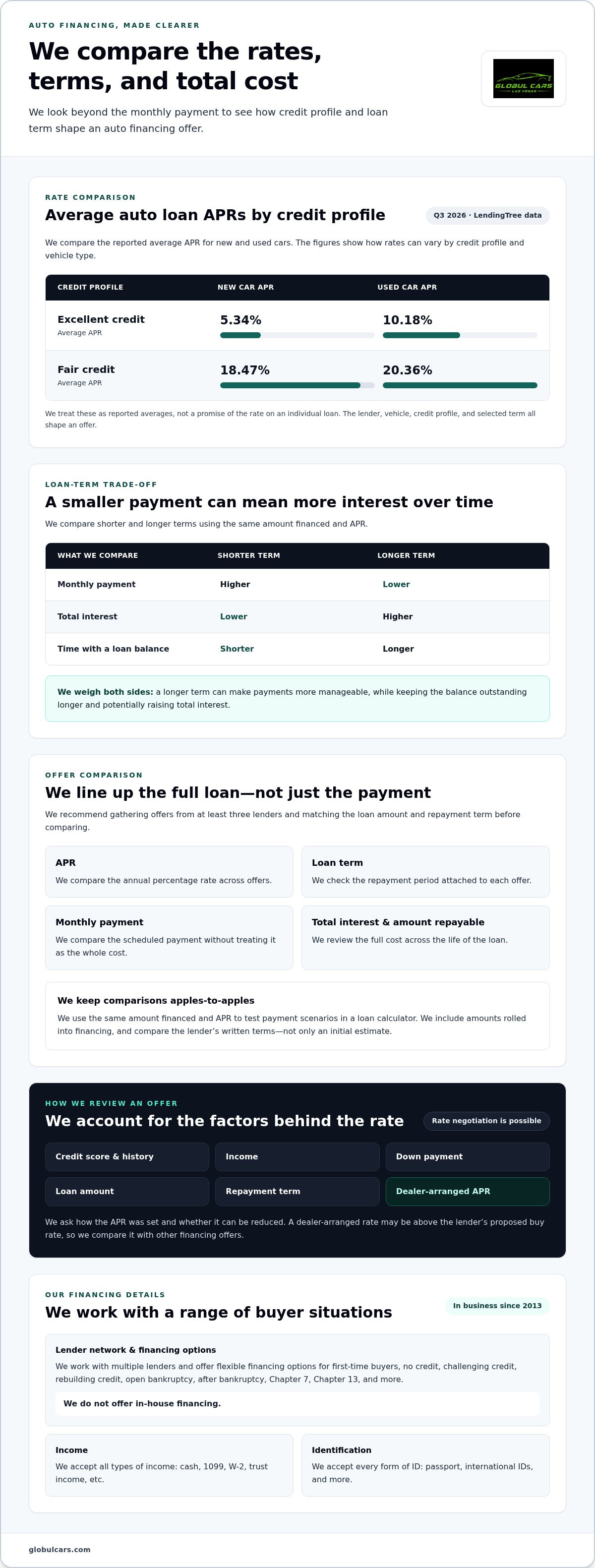
Use a loan calculator to test payment scenarios before choosing a term. Enter the same amount financed and APR, then compare payments and total interest across different terms. Change one input at a time. For example, hold the amount and APR steady while comparing shorter and longer repayment periods. This shows how a smaller payment can mean paying interest for longer. A calculator helps organize your options, but the lender’s written terms determine the actual loan.
When you compare, make each offer an apples-to-apples match. A different down payment or loan amount can make one payment appear lower even when its rate is higher. Include any amount rolled into financing when entering the loan balance. Ask each lender for the APR, term, monthly payment, and total amount repayable, then use those figures in the calculator. If you want to begin reviewing financing options, you can use this online financing application.
3. How loan term affects monthly payments and total interest
LendingTree data for Q3 2026 shows auto loan APRs vary by credit score and whether the vehicle is new or used. For excellent credit, average APRs were 5.34% for new cars and 10.18% for used cars; for fair credit, they were 18.47% and 20.36%. A longer loan term can lower the monthly payment but raise total interest. The lender, vehicle, credit profile, and selected term all shape the offer.
Compare the total cost, not just the payment. A higher monthly payment may not fit every budget, so weigh potential savings against what you can afford.
A larger down payment or trade-in can reduce the amount financed. That lower balance can reduce finance charges, but it doesn’t automatically change the lender’s interest rate.
Extending a loan term can make monthly payments more manageable, but it keeps the balance outstanding longer. Compare shorter and longer terms using the same principal and APR. Check both the monthly payment and total interest before choosing. Treat the lowest payment as one part of the decision, not the only measure of affordability.
Extra payments can shorten repayment and reduce interest when the lender applies them to principal. They don’t immediately lower the required monthly payment. You could add $50 or $100 to a monthly payment, or round a $360 payment up to $400. With biweekly payments, you make 26 half-payments, equal to 13 full payments each year. Confirm that extra amounts reduce principal, then consider whether that payment schedule suits your cash flow.
4. Negotiating an auto loan interest rate with a dealer
Negotiate before signing the auto loan paperwork, while the dealer-arranged offer is still under review. Bring a competing lender offer and ask whether the dealer can match or improve its APR. Keep the vehicle price, down payment, loan amount, and repayment term clear so a lower payment doesn’t hide a higher total cost. Understanding how to get a lower interest rate on a car loan starts with comparing written terms, not relying on a verbal estimate.
Negotiate the rate and loan terms separately. A lower payment may come from extending the term rather than reducing the APR. Ask for the APR, term, payment, and total interest in writing, then compare those figures with your other offer. If the dealer can’t improve the rate, you can decline the financing before signing and apply with a bank or credit union.
Use a lender’s offer as a specific starting point. For example, if a bank approves an auto loan at 8%, the dealer may present it at 10%. We recommend asking whether the dealer can reduce that rate and explain the final terms. Dealers may have an incentive to present a rate above the lender’s proposed buy rate, so a direct question can open a discussion. Negotiating can save hundreds or thousands of dollars over the life of the loan.
Most auto loans have fixed interest rates that stay the same over the loan’s life. Variable-rate auto financing is uncommon, and its rate can change as the prime rate or another index changes. An introductory variable rate may later become much higher than a fixed rate. Ask how either rate works and compare the full repayment terms, not just the starting payment.
Refinancing replaces your current loan with a new one that may have a lower rate, a different repayment timeline, or both. Consider it if your credit has improved, rates have fallen, or your financial situation has changed. A lower rate may reduce your monthly payment and total interest, but compare the new loan’s term and total cost with what remains on your current loan. If you’re weighing how to get a lower interest rate on a car loan after purchase, refinancing is one option to assess against your existing agreement.
Refinancing can initially affect your credit score because the application may involve a hard credit pull and a new loan. On-time payments afterward may improve your score over time. Review your current loan statement and compare it with the proposed replacement before agreeing. If you’ve already signed, you can still refinance through another lender offering a better rate. Compare the new terms with your remaining balance and repayment schedule.
5. Dealer buy rates and loan markups
With dealer-arranged financing, the dealer sends your application information to one or more lenders. A lender proposes a rate called the buy rate. The dealer may offer you a higher rate and may have an incentive to do so. That difference is a markup. Ask whether the offered APR is above the lender’s proposed rate and whether it can be reduced.
Some dealers receive a commission of 1% or 2% of the amount financed. That fact makes the final rate worth discussing, but it doesn’t tell you the markup on your individual loan. Your credit, income, down payment, purchase amount, and loan terms can affect the lender’s offer. Request the APR and financing terms in writing, then compare them with a preapproval from a bank or credit union.
Use a competing offer to negotiate clearly. Ask the dealer to match or improve the APR while keeping the purchase price, down payment, and repayment term unchanged. If the monthly payment changes, ask what changed in the amount financed or loan length. Compare total interest too, since a longer term can lower the payment without lowering the rate.
Federal and state laws can affect auto loan rates and dealer financing practices, but don’t assume one universal cap applies to every transaction. The relevant rules depend on the loan and jurisdiction. Focus on the written APR, amount financed, and itemized terms, and ask for an explanation of any rate difference you don’t understand.
Optional products can increase the total amount financed and the interest paid on that balance. Examples include service contracts, extended warranties, and insurance add-ons. Ask for an itemized breakdown of the products and amounts, then decide what you want before signing. If a product is optional, declining it can keep its cost out of the loan. Review the final paperwork to ensure the listed amount matches what you agreed to purchase.
To make a fair comparison, collect the dealer’s written offer and a separate lender or credit-union offer. Match the amount financed and term, then compare APR, payment, and total interest. Several applications in a focused rate-shopping period can help you compare options while limiting their impact on your credit. Use the online financing application to begin reviewing financing options.
Globul Cars: Vehicle Financing Solutions
Globul Cars offers Vehicle Financing Solutions for buyers comparing car loan options and pre-owned vehicles. We work with multiple lenders and offer flexible financing options for first-time buyers, no credit, challenging credit, rebuilding credit, open bankruptcy, after bankruptcy, Chapter 7, Chapter 13, and more. We don’t provide in-house financing; financing is arranged through lenders.
We accept all types of income, including cash, 1099, W-2, and trust income, along with every form of ID, including passports and international IDs. You can also explore pre-owned Mercedes-Benz, BMW, and Land Rover vehicles as you consider a purchase that fits your needs.
Contact Globul Cars or visit globulcars.com to discuss your next steps.
Take Your Next Step With a Clear Financing Plan
Before choosing a vehicle, decide what matters most in your budget: a manageable monthly payment, a shorter payoff timeline, or less interest over the loan’s life. Keeping that priority in view can help you assess offers without letting one appealing figure overshadow the full agreement. Your best financing choice depends on your budget and the terms available for the vehicle you select.
At Globul Cars, a local business in Las Vegas, we offer vehicle financing solutions and pre-owned Mercedes-Benz and BMW vehicles. If you’re ready to put what you’ve learned about how to get a lower interest rate on a car loan into practice, we can help you consider your financing options alongside your vehicle choice.
Contact Globul Cars about car loans to discuss your next step. You can move forward with a clearer plan and choose terms that work for you.
Frequently Asked Questions
Can I negotiate a car loan interest rate with the dealer?
Yes. Ask the dealer to review the offered APR and whether a lower rate is available. Request a written breakdown that separates the interest rate from the vehicle price, amount financed, and loan term. This makes it easier to identify what changed between offers. If you have another lender’s written terms, use them as a comparison point.
Are auto loan rates negotiable?
Yes. You can negotiate a dealer-arranged rate and compare it with separate offers from banks or credit unions. Focus on the APR and total repayment, not only the monthly payment. If the dealer proposes a different term or amount financed, ask for a revised breakdown before comparing. Keeping those details consistent helps you judge whether the rate itself improved.
How much can I save by refinancing?
There isn’t one savings amount that applies to every refinance. The difference depends on your current APR, remaining balance, time left on the loan, and the new offer’s term. Compare the total payments remaining on your current loan with the new loan’s total repayment. A lower monthly bill alone may not mean a lower overall cost if the replacement loan extends repayment.
Will refinancing affect my credit score?
It can affect your score at first. Applying may result in a hard credit inquiry, and opening a replacement loan changes your credit history. Before applying, check your current reports and avoid submitting unrelated credit applications at the same time. After refinancing, review your account records and make each payment on time. Payment history on the new loan may support your credit profile over time.
What credit score qualifies for the lowest auto loan interest rates in the US?
No single score guarantees the lowest rate across every lender. The rate data discussed in this article classifies excellent credit as 800 and above, but lenders also consider credit history, income, down payment, loan amount, and term. Treat score tiers as a guide, not an approval promise. Compare actual written offers for the vehicle and loan amount you’re considering.
How much can improving your credit score lower your car loan APR?
There’s no fixed APR reduction tied to a particular score increase. The change depends on how lenders assess your complete application, including payment history, outstanding balances, income, and requested loan terms. To see the effect, compare offers before and after improving your credit profile. Keep the vehicle, down payment, amount financed, and term consistent so the APR difference is easier to interpret.
How can I get preapproved for an auto loan from a bank or credit union?
Start by completing a prequalification or loan application with the bank or credit union you’re considering. Ask whether it uses a soft credit check for prequalification, then provide the requested details. Review the proposed APR, amount, and repayment term in writing. Preapproval can give you a financing reference while shopping, but compare the final loan agreement before accepting an offer.
How do I compare auto loan offers using APR, fees, and total cost?
Place each offer side by side and compare the APR, amount financed, loan term, scheduled payment, and total repayment. Check the itemized paperwork for optional products or other amounts included in the balance. If offers use different terms, calculate each using the same vehicle price, down payment, and repayment period. This helps reveal whether a lower payment comes from a better rate or a longer loan.


