

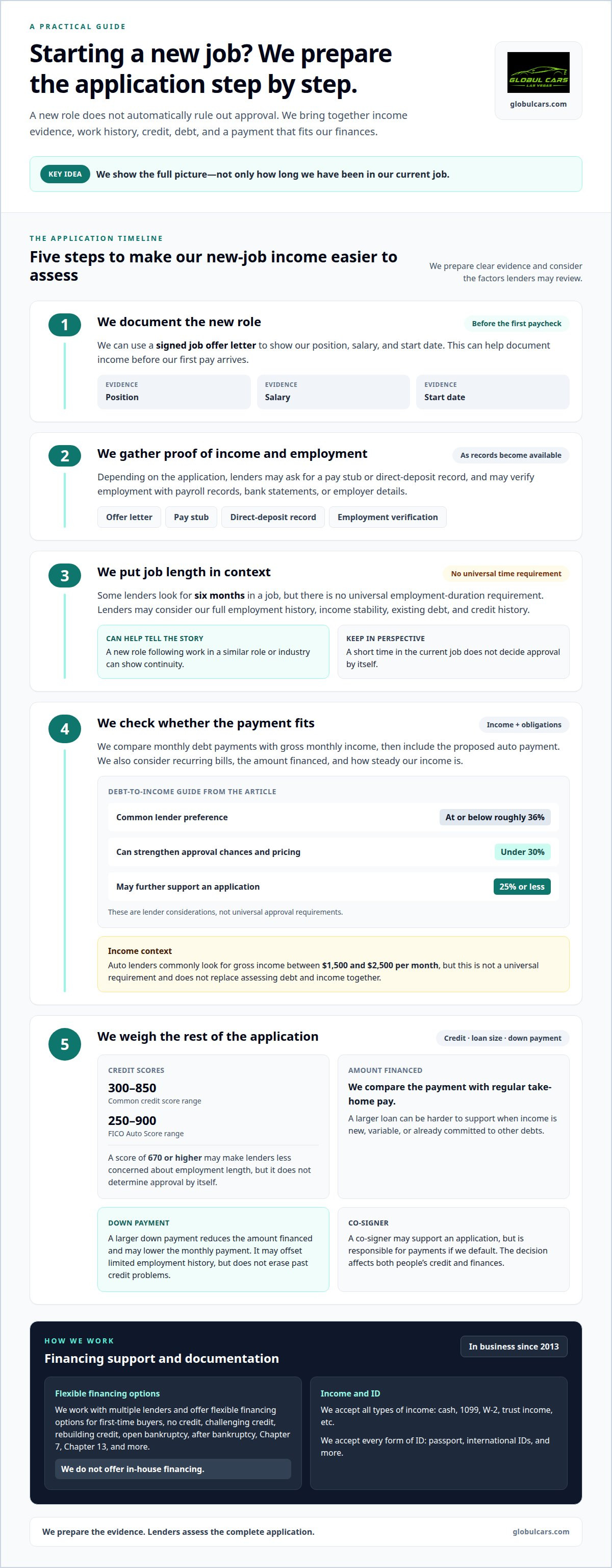
Yes, you can get a car loan with a new job. Lenders may consider your income, credit history, existing debt, and employment stability, so starting a new role does not automatically rule out approval. Some lenders look for six months in a job, but there is no universal employment-duration requirement.
It’s understandable to wonder how to show stable income before your first paycheck arrives. A signed job offer letter can document your position, salary, and start date, while lenders may also ask for a pay stub or direct-deposit record. The documents you have can shape how your application is assessed.
This article explains how job history, income, credit, debt, and a down payment can affect approval, including applications supported by a job offer. You’ll also learn how temporary work or a recent career change may factor in, and what lenders consider when deciding whether a payment fits your finances.
Key Takeaways
- A new job doesn’t automatically prevent approval; lenders may weigh your full employment history and income stability, not just time in your current role.
- A signed offer letter can help document your position, pay, and start date before your first paycheck arrives.
- Credit history, existing debt, and the amount you want to finance can all affect how an application is assessed.
- A larger down payment can reduce the amount financed and may help offset limited employment history.
- Gathering clear income documents and setting a realistic budget can help you prepare for the application process.
Credit scores, down payments, and loan amounts
Auto lenders don’t use one universal credit score or debt-to-income ratio requirement. A credit score commonly ranges from 300 to 850, while the FICO Auto Score ranges from 250 to 900; lenders also weigh income, credit history, existing debt, and employment stability.
These factors matter together. A strong credit history may help offset a short employment history, while a recent job change alongside missed payments or substantial debt can make an application harder to assess. A score of 670 or higher may make lenders less concerned about employment length, but it doesn’t determine approval by itself.
Credit checks are another part of applying. A prequalification review may use a soft credit inquiry, which does not affect your credit score; a formal application may involve a hard inquiry. The type depends on the lender’s process, so prequalification can give you an initial sense of potential terms before you proceed with a full application.
A down payment reduces the amount you need to finance. That smaller loan can lower the monthly payment and may help offset limited employment history. A higher down payment does not erase past credit problems, but it reduces the lender’s exposure.
The loan amount matters because lenders assess whether the payment fits your income and existing obligations. A larger loan can be harder to support when your income is new, variable, or already committed to other debts. Compare the amount financed with your regular take-home pay, not just the vehicle’s advertised price. Include recurring bills when estimating what payment your budget can handle.
A co-signer may strengthen an application if they have consistent income, a high credit score, and a good debt-to-income ratio. They also accept responsibility for the loan payments if you default, so the decision affects both people’s credit and finances. A co-signer can support your application, but does not replace the lender’s assessment of your income and credit history.
For applicants with fair or poor credit, employment history can help show continuity, especially when a new job follows work in a similar role or industry. Consider a practical sequence: review your credit report, calculate existing monthly debt against gross monthly income, choose a manageable loan amount, then assess whether a larger down payment or co-signer could help. Lenders commonly prefer a debt-to-income ratio at or below roughly 36%; under 30% can strengthen approval chances and pricing, and aiming for 25% or less may further support an application.
Debt-to-income ratio
A debt-to-income ratio compares monthly debt payments with gross monthly income. Lenders also assess whether your income is steady enough to support an auto loan payment alongside existing obligations.
Debt-to-Income and Affordability
Debt-to-income ratio, often shortened to DTI, shows how much of your gross income goes toward monthly debt payments. Lenders use it to judge whether a proposed car payment fits alongside obligations such as rent, credit cards, or student loans. If you recently started work, consistent income and a manageable payment can help demonstrate affordability, even with a short employment history.
For example, list your recurring debt payments, then compare their total with your gross monthly income. Include the proposed auto loan payment in your budget instead of looking only at existing bills. A lender may also consider income stability, the amount financed, and your credit history. If your income varies month to month, using a lower expected income gives you a more realistic picture of affordability.
Auto lenders commonly look for gross income between $1,500 and $2,500 per month, though this isn’t a universal requirement. That range is one consideration, not a substitute for assessing debt and income together. A borrower earning within it may still face affordability concerns if existing obligations use much of that income. Conversely, other application details can affect how lenders evaluate the full picture.
Alternative Income and Benefits
Alternative income is money outside a standard paycheck, such as Social Security, alimony, investment dividends, interest, rental property income, or unemployment benefits. Lenders may consider these sources when assessing repayment ability. Regularity and documentation matter: dependable income can support affordability, while income that changes frequently may require closer review.
Unemployment does not automatically rule out an auto loan; some lenders may consider applicants who meet their other requirements. However, without job income, the application may depend more heavily on other documented income, credit, debt, and down payment. Unemployment benefits may count as income, but they do not by themselves show that a proposed payment fits your budget.
Self-employed borrowers typically need two to three years of tax returns to demonstrate income stability. If you’re between jobs, the previous year’s tax return may help document income. Tax records show earnings over time, while current bank statements or other income documents can help explain what you’re earning now. Use figures that match your records rather than estimates.
Other income types can also shape the assessment. For example, a borrower with W-2 wages and rental income can document each source separately, making the overall picture easier to understand. Applicants with low income should focus on the relationship between reliable income, existing debt, and the payment they can manage. For a financing application, start with our online application.
Employment Length for Car Loan Approval Chances
Depending on your application, auto lenders may request pay stubs, an offer letter, or employment verification. They verify income and employment through documents such as payroll records, bank statements, or employer details.
Application and Employment Documents
Employment documents show your current role, earnings, and work history, helping lenders assess an application when your job is new. If you haven’t received a pay stub, gather a signed offer letter or employment verification letter. An offer letter is most useful when it identifies you and your employer, and states your position, start date, and pay rate.
Employment history adds context. For example, moving to a similar role in the same industry may show continuity despite a short time with your current employer. Some lenders use six months at a current job as a guideline, while others may consider your broader work history. A probationary period or not yet receiving your first paycheck may prompt closer review.
Pay Stubs and Income Verification
Pay stubs document earnings after you start work, including gross and net pay and the pay-period dates. Lenders may request 1-2 recent pay stubs, but the required number can vary. A first-time employee may use an offer letter before receiving a stub; an employer letter can also verify a new hire’s position, salary, and start date.
For a new job, two or more pay stubs with a set schedule can show a visible income pattern. If you’re within the first 30 days, clear proof reflecting your current employment can help support the application. Bank statements showing recurring payroll deposits may corroborate income, or help when pay stubs aren’t available. Lenders may review 1-3 months of statements.
Use exact income figures from your pay stub or offer letter rather than rounding up. A lender may also verify employment using employer contact details or an employment verification letter. Keep your documents consistent: mismatched pay, dates, or employer details can make your current income harder to assess.
Vehicle and trade-in details can clarify how much you’re asking to finance. If you plan to trade in a vehicle, bring its identifying information and records showing any loan balance. These details help distinguish the trade-in contribution from the amount financed for your next vehicle.
Before applying, organize your income and employment records. A useful set of documents may include your offer letter, available pay stubs, and bank statements showing payroll deposits. If you recently changed jobs, a verification letter can explain your current position and start date. Clear records help lenders assess whether your income supports the loan you’re requesting.
Down payment and loan-term tradeoffs
A down payment reduces the amount financed, while the loan term affects the payment size and total borrowing cost. If you have a new job, both choices can shape how affordable an auto loan looks to lenders.
Down Payments and Approval
A down payment is the amount you pay upfront toward a vehicle, reducing the balance financed. Those figures are general benchmarks, not universal approval rules. A lender also considers income, credit, debt, and employment stability.
A larger upfront contribution can improve your approval chances by reducing the loan amount. For example, the same down payment represents a larger share of a less expensive used vehicle’s price. That can lower the financed balance, but it does not replace the lender’s assessment of your ability to make payments.
Larger Down Payments
A larger down payment means borrowing less, which can make a proposed loan more manageable. It may also help offset a short employment history, since lenders assess the amount requested alongside your income and other application details.
Consider how much cash you can contribute without leaving too little for regular expenses. For example, compare two possible down payments with the resulting loan balance and monthly payment. The better choice reduces borrowing while leaving enough savings for everyday needs.
If you’re trading in a vehicle, its value may contribute toward your next purchase. Include any amount you still owe when estimating the trade-in’s effect. The resulting balance, rather than the down payment alone, helps determine how much you need to finance.
Choosing an Affordable Payment
An affordable payment fits your regular budget alongside existing debt and essential costs. A longer loan term can lower the monthly payment, but increases the total cost and keeps you in the loan longer. Compare the full loan cost as well as the monthly amount before choosing a term.
Start with your dependable income, then account for rent, debt payments, and other recurring bills. For example, if a shorter term makes the payment difficult to manage, a larger down payment may reduce the balance. If that would use money needed for essentials, a less costly vehicle may be a better fit.
When your job is new, base your budget on income you can document. Employment verification can support your application, but lenders still assess whether the proposed payment fits your overall finances. Make sure the amount financed, term, and payment work together before accepting loan terms. A lower payment alone does not show whether the total borrowing cost is manageable.
Car loans with a job offer letter
A signed offer letter can help document new employment before your first paycheck arrives. It gives lenders details about your upcoming role, but they still assess your full application, including income, credit history, and existing debt.
A useful letter identifies you and your employer, states your position and start date, and gives your pay rate. A pay schedule and employer contact details can make those terms easier to verify. Use the exact income shown in the letter or pay stub. Do not estimate or round up: the lender needs figures that match your records.
If you haven’t started work, submit the offer letter as evidence of your upcoming employment. Lenders may accept an employer letter or signed offer letter showing your position, salary, and start date. Some may also ask for your first pay stub or a direct-deposit record. The key question is whether your documents show income clearly enough to assess the payment you’re requesting.
Once you start work, pay stubs can connect the offer to your actual earnings. For example, an offer letter might show an annual salary, while your first pay stub confirms gross pay for a specific period. If the stub differs because of hours, commission, or deductions, use the documented figures rather than assuming the offer amount equals your take-home income.
A typical review considers more than the letter. Lenders may assess your credit score, current debt, income, and job stability alongside the loan amount. A strong credit history or manageable obligations can help present a clearer overall picture, while a payment that is unusually large compared with documented income may raise affordability concerns. An offer letter supports the employment part of your application, but does not replace the rest of the underwriting review.
Before applying, organize your offer letter with any available pay stub and records of recurring deposits. Make sure your name, employer, role, start date, and pay details agree across the documents. If you have not received a paycheck, the letter should accurately describe your agreed pay and schedule. This gives the lender a clear picture of where your income will come from.
We can use offer-letter details as part of a financing application. Start with our online financing application and provide accurate employment and income information.
Globul Cars
Globul Cars offers Vehicle Financing Solutions for buyers considering a vehicle after starting a new job. We’ve been in business since 2013 and work with multiple lenders, offering flexible financing options. We don’t provide in-house financing.
We accept all types of income: cash, 1099, W-2, trust income, and more. We also accept every form of ID, including passports, international IDs, and more. Our pre-owned Mercedes-Benz and luxury vehicles are among the options you can consider alongside your financing needs.
Contact Globul Cars in Las Vegas to discuss your financing application and vehicle needs.
Take the Next Step Toward a Car That Fits
If you’re asking whether you can get a car loan with a new job, make your next step a clear financing conversation. Gather your employment and income details, decide what payment fits your budget, and consider which type of vehicle meets your needs. This turns a recent job change into specific information for your application.
At Globul Cars, a local business in Las Vegas, we offer vehicle financing solutions alongside pre-owned Mercedes-Benz and BMW. We work with multiple lenders and can consider financing options in light of your income, credit profile, and vehicle needs. Approval depends on the lender’s assessment of your full application, so accurate information and a realistic budget are useful starting points.
When you’re ready to discuss your situation, contact Globul Cars. We can talk through your financing needs and vehicle options. A new job is a fresh start, and a thoughtful plan can help you move forward with confidence.
Frequently Asked Questions
Can I Get a Car Loan with a Temporary Job?
Yes, a temporary job can support an auto loan application if your income and ability to repay are documented. Lenders may consider your contract, expected work duration, earnings, credit history, and existing debt. For example, a temporary worker with regular hours can show the pay pattern through recent records. A larger down payment or a co-signer may also strengthen an application, though each affects the financing arrangement.
Can I get car finance after starting a new job?
Yes, you can apply after starting a new job. If you’ve received a paycheck, use it to show your actual earnings; if not, an employment letter may help explain your new role and pay. For example, someone moving directly from one job to another can provide records from both roles to show continuity. Lenders assess those details alongside the payment requested and other financial obligations.
What if you recently changed jobs?
A recent job change does not automatically prevent you from qualifying. Explain the transition with accurate employment dates and current income records. Moving to a similar role or industry can help show that your work and earnings remain consistent. For example, a nurse changing hospitals can document the new position and pay while showing prior employment. A move to a different field may lead lenders to examine income stability more closely.
Can I Get a Car Loan with a Job Offer Letter?
Yes, a job offer letter may support a car loan application before your first payday. It should identify you and your employer and show your position, start date, and pay rate. For example, if your start date is approaching, the signed letter can document expected employment while you wait for a pay stub. Lenders may still ask for additional proof, such as a first paycheck or payroll deposit.
Can I Get a Car Loan with a Part-Time Job?
Yes, part-time work can count as income for an auto loan application. Lenders assess whether your documented earnings, together with any other income, can support the proposed payment and existing debts. For example, someone working variable shifts can provide recent pay records showing actual earnings rather than relying on an estimated schedule. A lower loan amount may be more manageable when weekly hours change.
Can I get a car loan with a new job before completing three months?
Yes, you may apply before completing three months at a new job. Three months is not a universal employment-duration requirement, and lenders can weigh your offer letter, pay records, prior employment, credit, and debt. For example, an applicant who has started a similar role and received pay can show both current earnings and work continuity. What matters is the evidence supporting affordability.
Can you get a car loan with a new job?
Yes, you can get a car loan with a new job if your application shows income that can support repayment. Approval depends on more than your start date: lenders assess credit, debts, the amount financed, and employment information. For example, a signed offer letter may help if you haven’t received a paycheck yet. Choosing a vehicle that fits your budget can keep the requested payment realistic.
How long must you be employed to qualify for an auto loan?
There is no universal minimum period you must work before applying for an auto loan. Six months is sometimes used as a rule of thumb, while some lenders may assess your broader employment history instead. For example, a borrower who has spent little time in a new role may show prior work in the same industry. Lenders also consider income stability, credit, debt, and the amount requested.


